Private Luxury, Public Artistry
Editorial
Private Luxury, Public Artistry

Parmigiani Fleurier has always been a brand that speaks softly but demands close attention. It is a house born from the hands of a restorer, the mind of a watchmaker and the eye of a classicist. Yet it took the arrival of Guido Terreni in 2021 to turn that quiet mastery into a contemporary language — one that connoisseurs could hear above the market din without the brand ever needing to raise its voice.
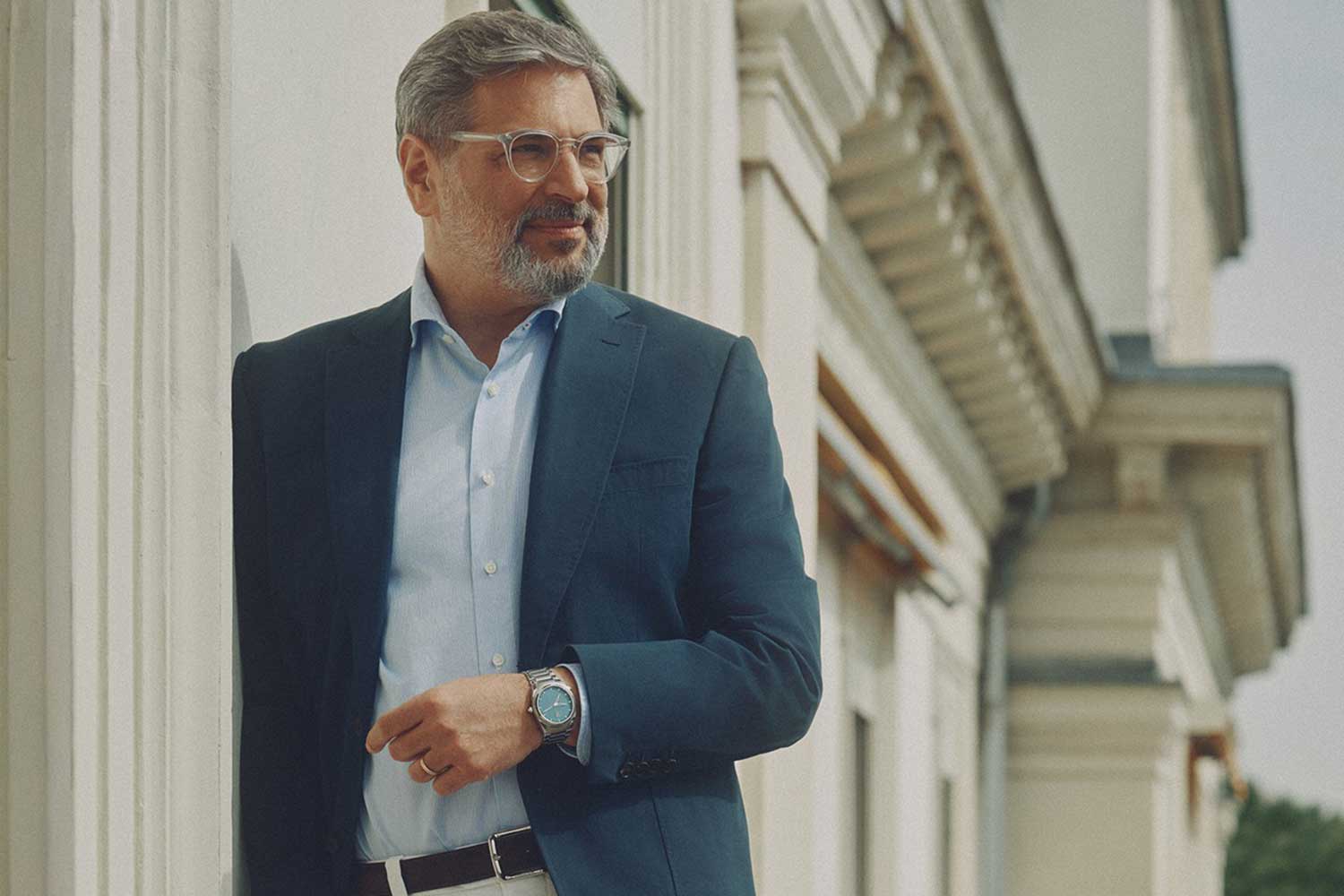
Parmigiani Fleurier’s CEO, Guido Terreni
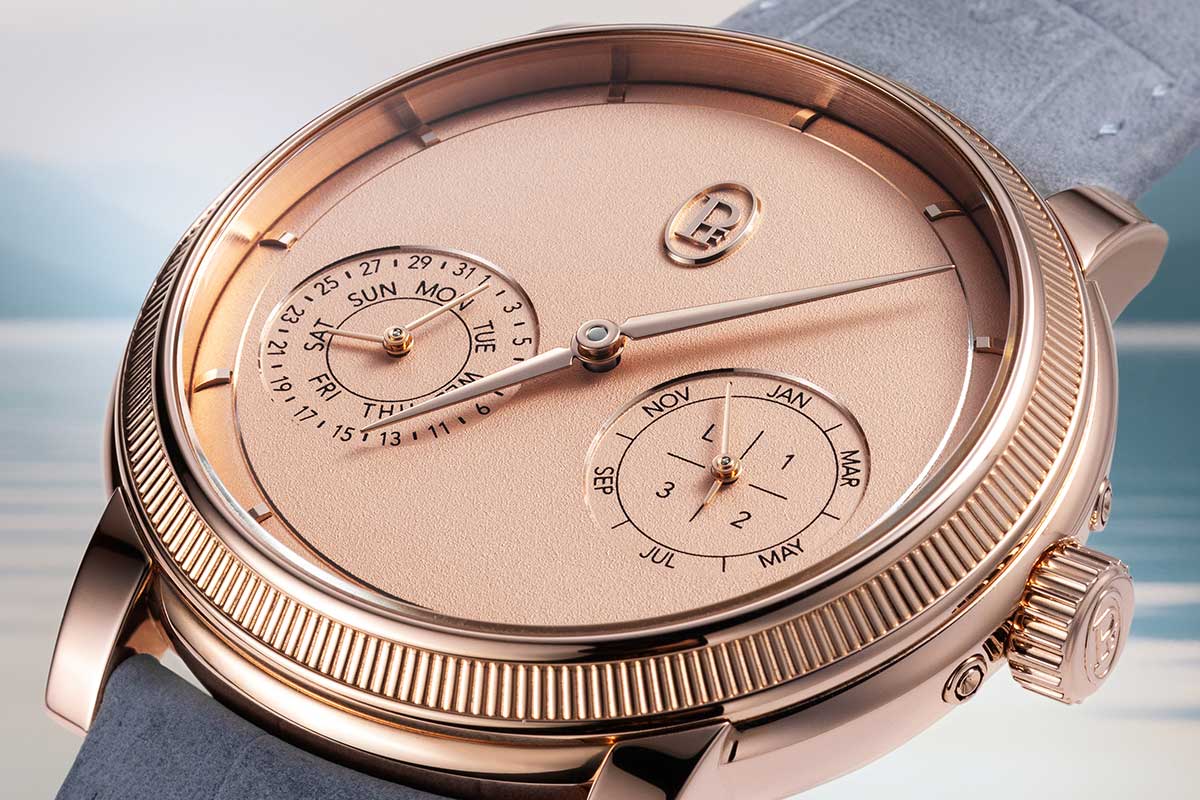
This year’s Toric Perpetual Calendar — not least the model cased in gold with a hand-worked gold dial — is the brand’s most eloquent declaration to date. It is not a watch that shouts its complication; rather, it articulates it. The Toric QP is a masterclass in restraint, born of a simple proposition Terreni repeats like a mantra: simplify the complication, dignify the craft and serve the owner rather than the onlooker. Or, as he puts it, “We are about subtlety… about going to the essence of the idea.”
Offered in two limited editions of 50 pieces each, the Toric QP comes in the “Golden Hour” execution, pictured on our cover and cased in rose gold with a hand-grained golden dial, as well as in a platinum “Morning Blue” version. Both share the same quiet eloquence, the blue expressing calm, morning clarity while the gold glows with warmth and late-afternoon light.
-
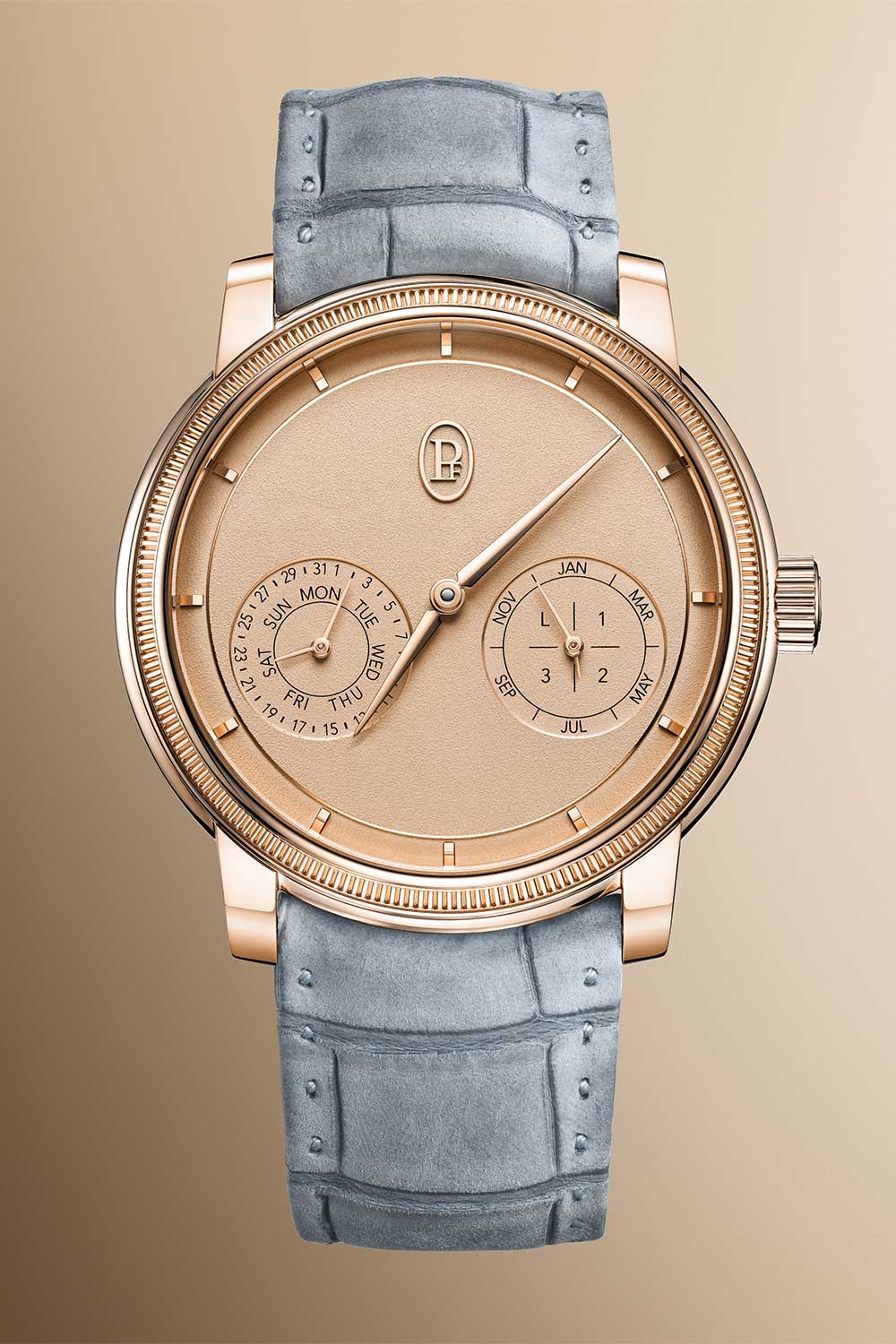
- Toric Quantième Perpétuel “Golden Hour”
-
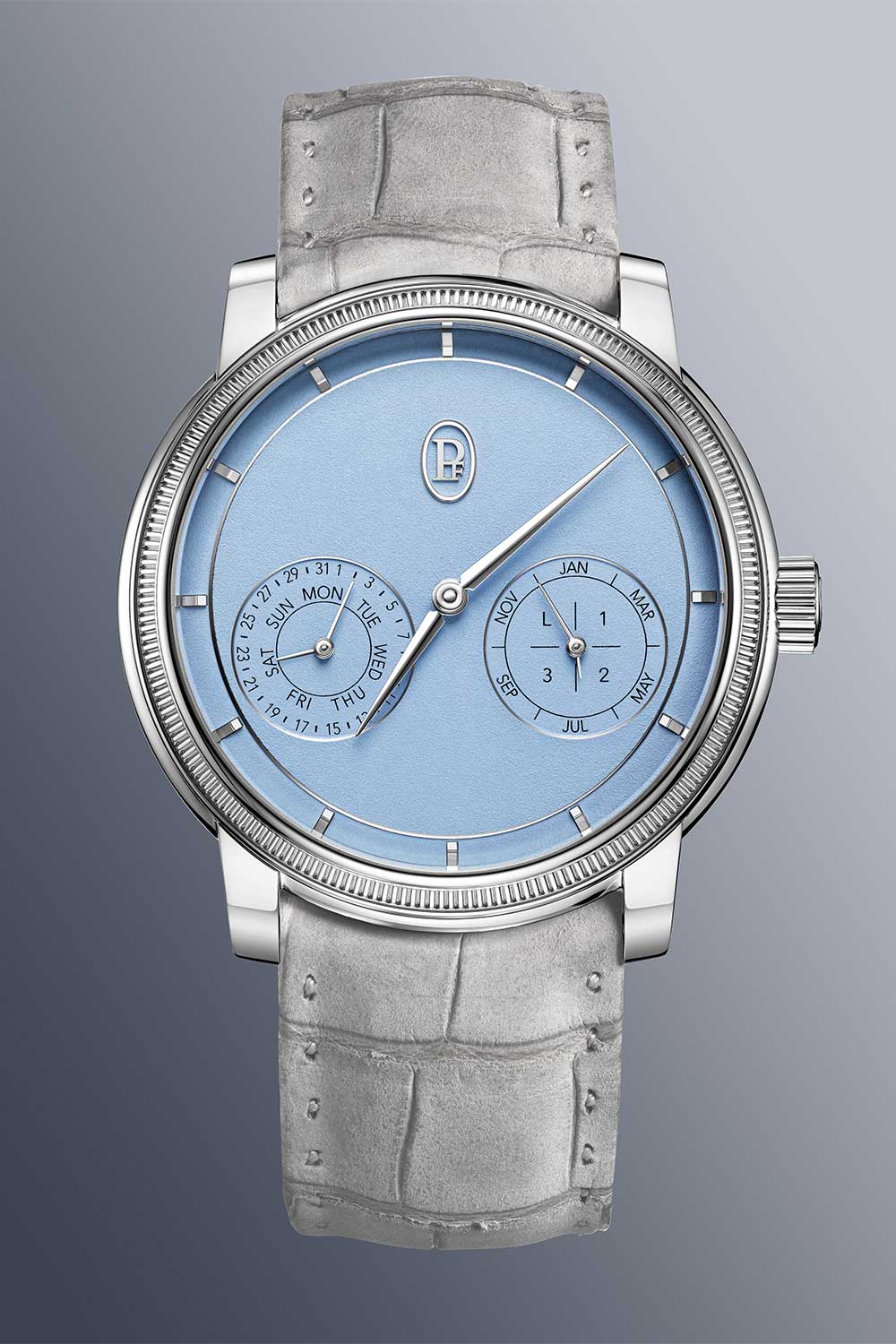
- Toric Quantième Perpétuel “Morning Blue”
This is the story of how Parmigiani rediscovered its voice and why the Toric QP may be the season’s most persuasive argument that elegance, when pursued seriously, is a form of horological courage.
From reverence to relevance
Terreni’s first encounter with Parmigiani dates to the year 2000, when a platinum limited edition bearing a Parmigiani movement appeared inside another brand’s case. “I was seven days into working in the watch industry,” he recalls, “and I heard about this brand that everyone described as extremely prestigious and important in the culture of watchmaking.” Over the next two decades he would remain a client of Parmigiani’s manufacture, quietly admiring the depth of its know-how.
When he was scouted to take the helm in 2021, he saw not a failing maison but an under-expressed one. “Parmigiani had all the ingredients in its history,” he says. “What was missing was the creative direction that could focus the teams around a vision to serve the connoisseur of tomorrow… someone who understands the mechanical art, seeks refined craft and wants to design watches that are suitable for today’s world.” The brief was as demanding as it was romantic: to create a collection for an “unostentatious customer” who is “very discerning — so you cannot fake it.”
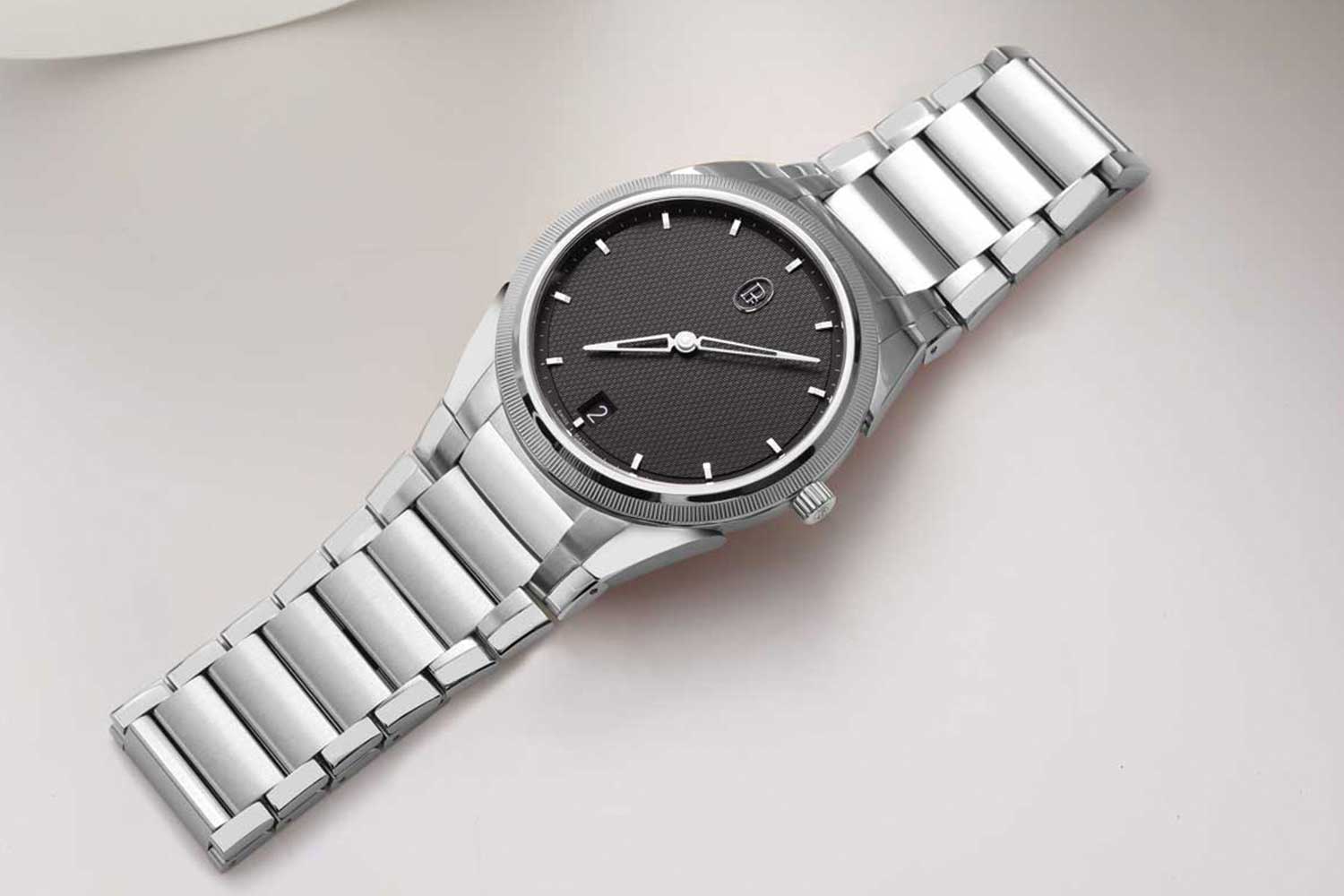
2021: Parmigiani Fleurier Tonda PF
The timing, curiously, was perfect. The pandemic had pressed pause on supply while leaving demand intact, and Terreni used the disruption to rethink the product from first principles. “Let’s invest this time in doing an introspective work,” he told his team. He stopped launches that were “tactical,” reframed the brand’s purpose, and, in just seven months, debuted the Tonda PF — a suite of seven references across four movements that, in hindsight, read like a proclamation. “It was an alignment of the stars,” he says. “Once we presented it, the company changed face.”
The watch press and collectors sensed the pivot instantly. Parmigiani would not pursue attention. It would earn respect.
Defining private luxury
In an era where fashion has co-opted the language of “quiet luxury,” Terreni is careful to make a distinction that feels almost moral. “Quiet luxury has become a trend,” he says. “Private luxury is not a trend. It’s behind the scenes; it’s a maturity of taste. You buy for yourself, not for social recognition.”
Private luxury, then, is the owner’s privilege rather than the passerby’s advertisement.
This explains the PF badge at 12 o’clock on Tonda PF dials — a graphic whisper to the wearer instead of a blaring signal to the world — and it explains the Toric’s refusal to onload visual clutter in the name of proving its price. “Our customer doesn’t want to be seen,” Terreni says. “He wants to be understood.”
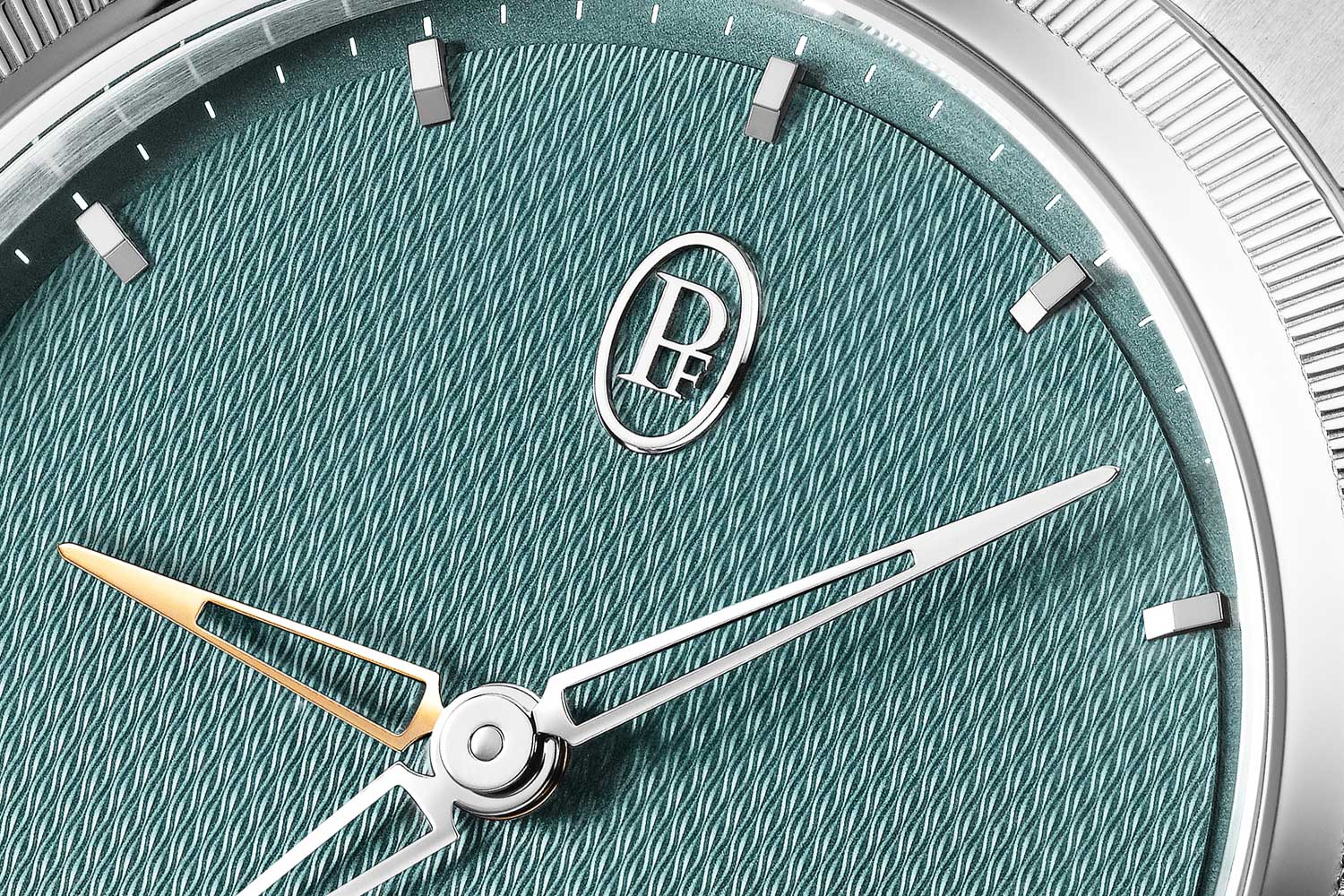
The PF badge at 12 o’clock on Tonda PF dials, is a graphic whisper to the wearer instead of a blaring signal to the world
This ethic guides everything from color to typography. Parmigiani’s dials cleave to “peaceful” palettes — from the soft Morning Blue of platinum to the warm Golden Hour of rose gold — that calm rather than clamor. Indexes are slim, scales are reduced, surfaces are hand finished to catch light without hard reflections. “You’re not showcasing the wealth you have,” he says of a Parmigiani client. “You’re showcasing your knowledge and your refinement, things money cannot buy.”
The Toric returns: A dress watch for now
The Toric was Parmigiani’s first serial design in the 1990s, and its return under Terreni is deliberate. If Tonda PF states Parmigiani’s everyday elegance in steel and precious metals, Toric reclaims sartorial territory — an elegant watch for a contemporary wearer who still believes in tailoring, even if he or she no longer requires it for everyday wear.
Terreni, a close observer of menswear, frames it historically. For a century, people wore the black-and-white language of a bourgeois uniform; the watch moved from pocket to wrist and adapted to that restraint. Postwar, color entered the wardrobe and the dial; late in the 20th century, the suit — and with it, the daily dress watch — was discarded in favor of new-economy nonchalance. “And then, about 15 years ago, young people started to rediscover the pleasure of wearing fine clothes,” he notes. The Toric is Parmigiani’s answer to that renewed appetite for refinement: handmade finishings, artisanal dials, a case whose curves speak softly but unmistakably of craft.
“We are never about replicating our past,” Terreni insists. “We replicate our values.” Those values — discretion, restoration-grade finishing, innovation through tradition — derive from Michel Parmigiani himself. The founder’s double nature, as Terreni describes it, is a poet’s juxtaposition: the ascetic humility of the restorer and the relentless curiosity of the inventor. “His craft speaks for him,” says Terreni. “Nothing else.”
The Toric embodies both. It borrows Breguet’s civility — Michel restored Breguet pieces for years, and the lineage shows in the Toric’s fluted bezel and fine minute scales — yet it speaks in the present tense. The bezel is slender and tactile, the lugs are deliberately short for a graceful drape, the case fattens just below the bezel so your fingertips register precious metal before your eyes do. “When you touch the case,” Terreni says, “you feel this abundance of gold.”
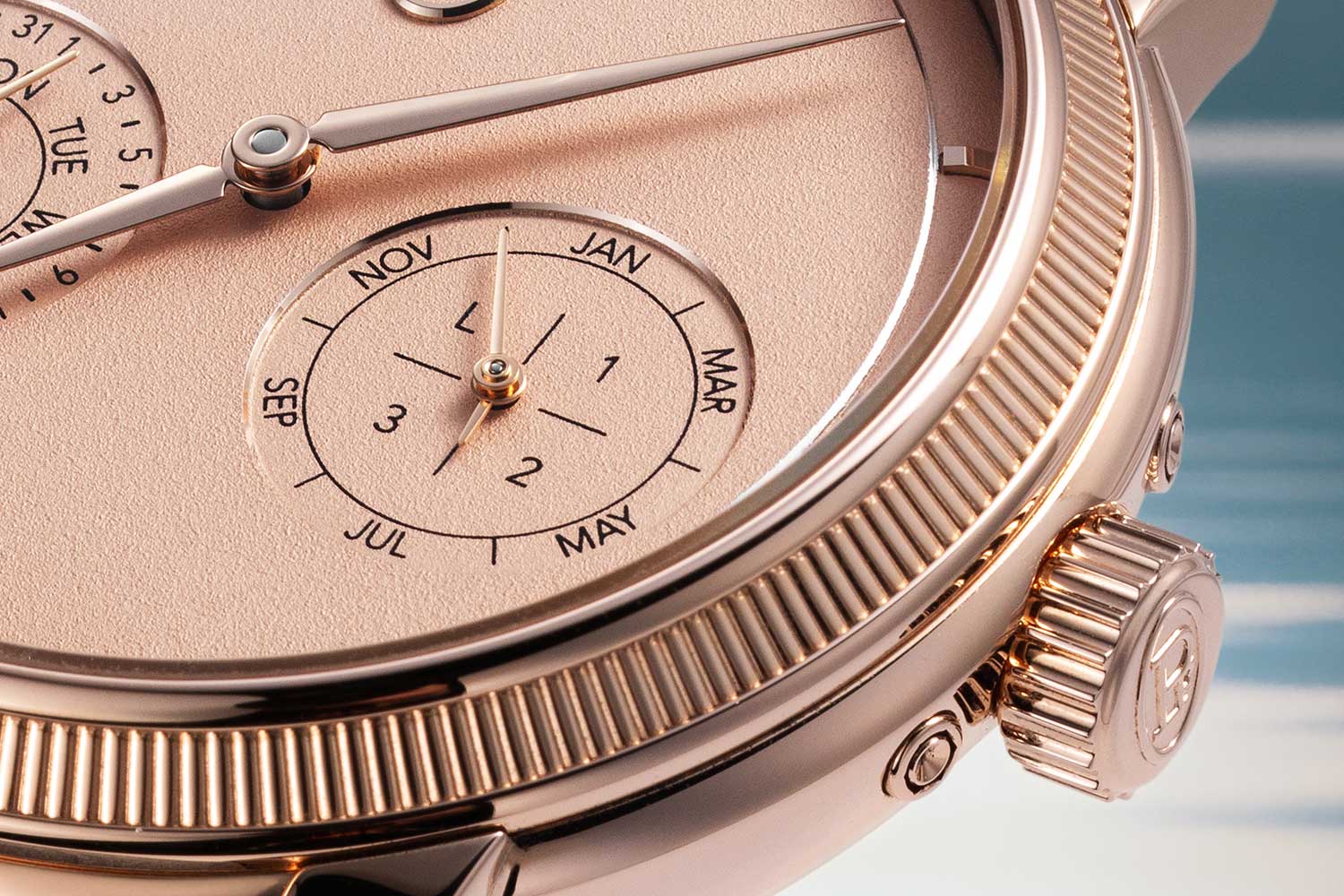
The fluted bezel and fine minute scales
A perpetual calendar that refuses to shout
The perpetual calendar is a paradox: it promises perpetuity yet usually demands attention in the present. Many are crammed with sub-registers, apertures and moonphases that scream complexity. Parmigiani’s Toric QP takes the opposite path. It is a dress watch first and a perpetual calendar once you look deeper.
“We love purity,” Terreni says. “I’m not a fan of busy dials.” The design team split the calendar information into two co-axial counters positioned just under the 3 and 9 o’clock horizon. No disk overlaps, there are no lopsided masses of text. The day and the month are read effortlessly; the date, naturally; the leap-year indication is integrated without theatrics. The moonphase was eliminated altogether. “It’s an additional information,” Terreni shrugs. “It’s pleasant but tangential to the complication’s essence.”
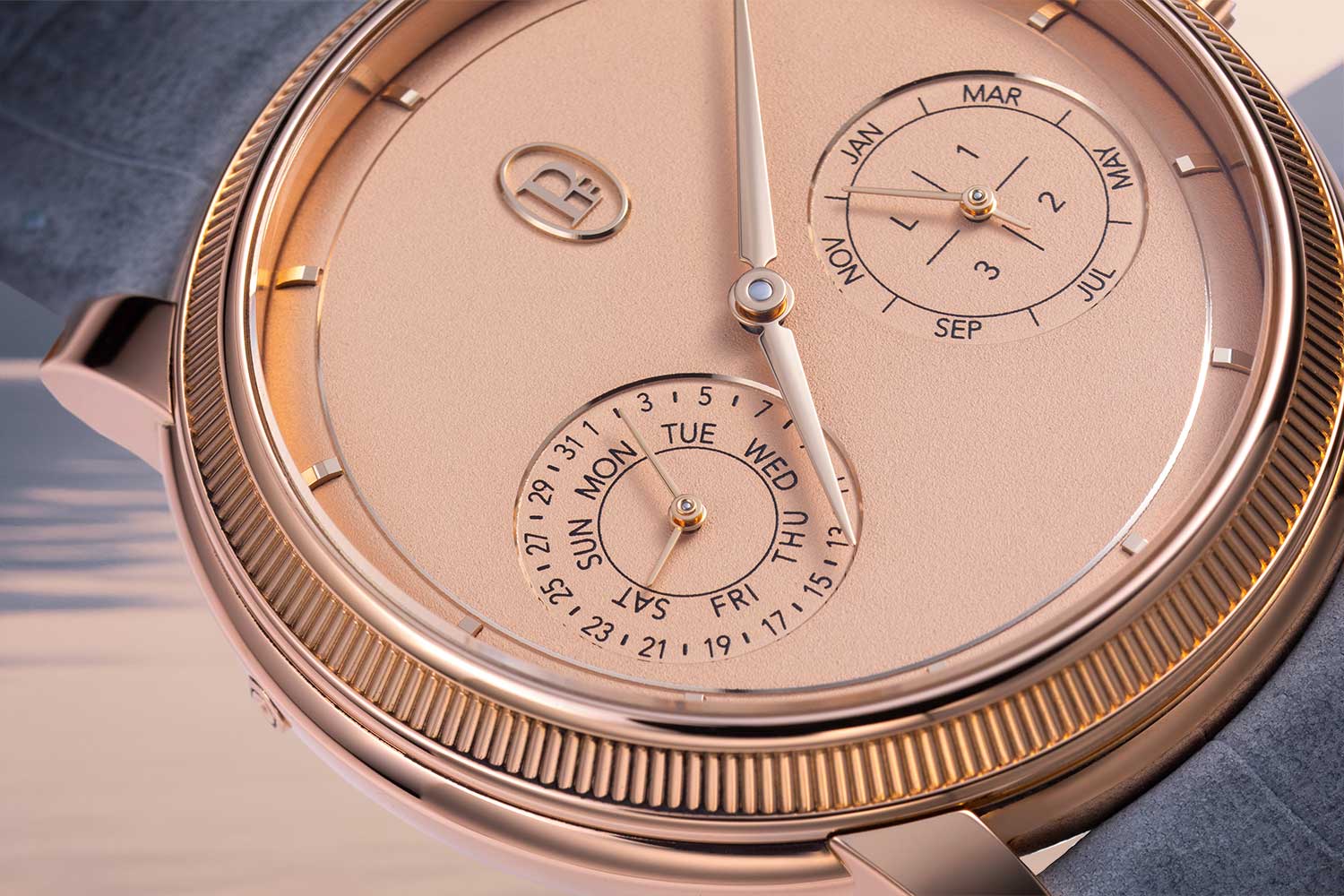
With total purity, the calendar information is displayed on two co-axial counters positioned just below 3 and 9 o’clock, making reading effortless
Inside beats the manual winding Caliber PF733 — a movement crafted entirely in solid 18K gold and finished to haute horlogerie standards with Côtes de Fleurier and hand-beveled bridges. Choosing a manual caliber rather than an automatic underscores Parmigiani’s philosophy of intimacy: you engage with the watch each day, winding it by hand, feeling the mechanism as part of the ritual.
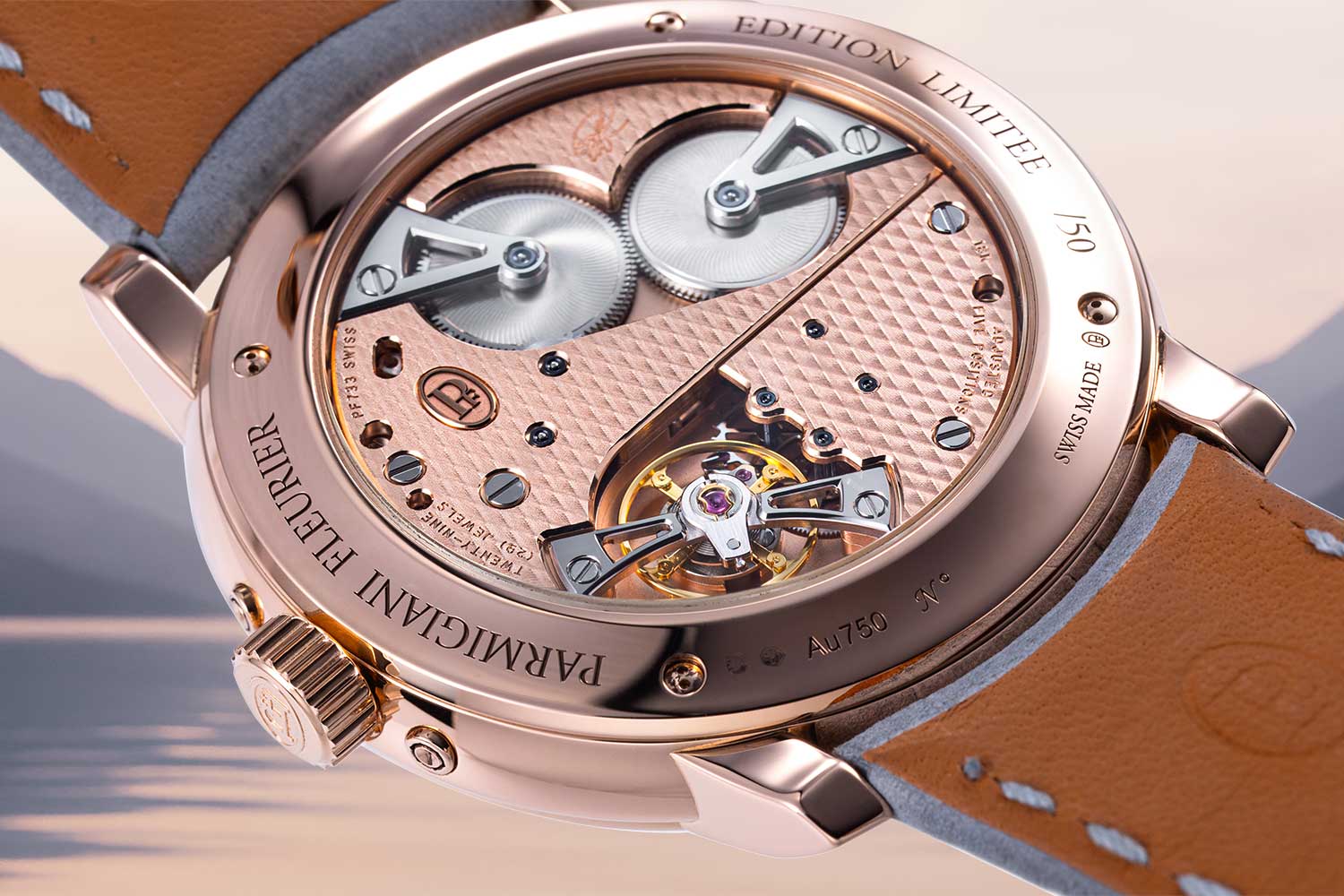
The manual winding Caliber PF733 is created entirely in solid 18K gold with finishes including Côtes de Fleurierand hand-beveled bridges
The twin-counter architecture gives the Toric QP a sense of serenity — day, date and month read as naturally as hours and minutes. It’s a cleaner, more meditative display than traditional four-subdial perpetuals, designed to serve the eye rather than impress it.
What remains is a dial that breathes: perfect negative space, crisp typography, and a surface that comes alive in oblique light thanks to a finishing technique — grené main — that feels as rare in 2025 as a maître d’ who knows your name and your drink. Terreni is candid about the color choice for the platinum model’s “morning blue”: it was an accident. The supplier delivered a hue lighter and cleaner than requested just before a product meeting. “When I saw it, I said: this is fantastic. Can you repeat the mistake?” He could. Approval granted.
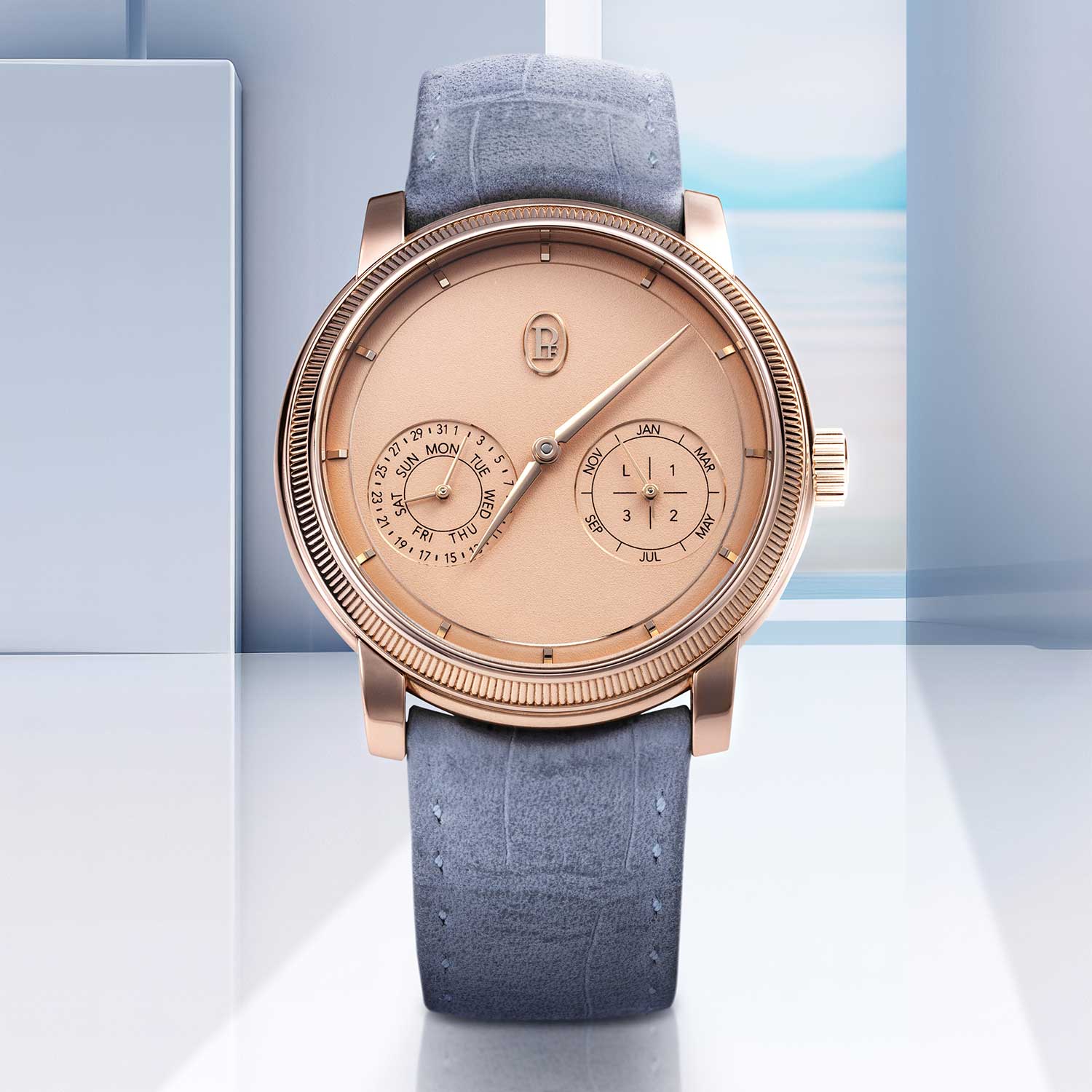
The dial is allowed to breathe with perfect negative space, crisp typography and a traditional grené main finish that brings it all to life
That platinum “Morning Blue” now forms one half of the Toric’s dialogue. Alongside the “Golden Hour,” the pair are twins, inseparable in mood, yet direct opposites aesthetically: dawn and dusk rendered in metal and light.
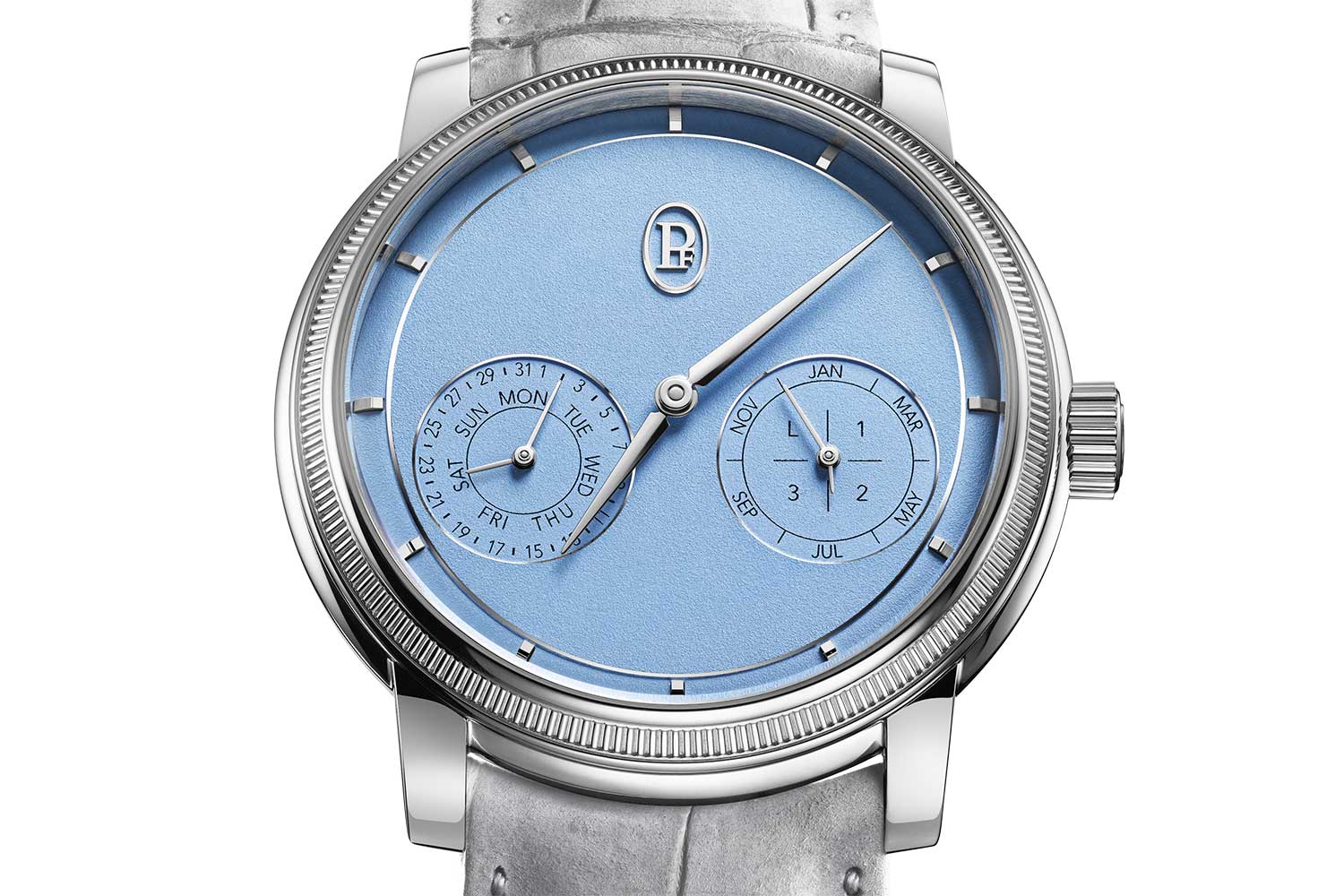
The platinum Toric Quantième Perpétuel “Morning Blue” is the yin to the yang of the “Golden Hour” model
Architecture in gold
The Toric QP’s most seductive trick is how gold is used not merely as cost or for status, but as a medium for light. “We see thanks to light,” Terreni reminds me, “and we see through the support the light hits. Finishing is the mixture of the two.”
Parmigiani’s dial is made of solid gold, then hand brushed using a paste Michel Parmigiani introduced from his restoration practice — a mixture of silver powder, cream of tartar, distilled water and sea salt. With a stiff boar-hair brush, the dial maker abrades the gold until it takes on a fine, matte grain. Because the chapter-ring recess sits lower than the main plane, the brush “jumps” between levels with slightly different pressure. The resulting micro-variation in grain is imperceptible to the naked eye but palpable in character. It is the fingerprint of the hand at work.
Color is applied not by lacquer, which would drown the texture, but by physical vapor deposition (PVD) a few microns thick, just enough to tint without choking. The dial’s architecture — chapter ring and recessed counters — is then “revealed” by drilling away the PVD so that the underlying gold returns to sight. The bevels of the apertures and scales are mirror polished; the chapter ring curves gently down; the indexes sit discreetly at the periphery.
Turn the watch over and the lesson in light continues. Bridges rendered in gold reflect differently from brass, their côtes and anglage catching light with a warmth you feel rather than see. Parmigiani’s signature Côtes de Fleurier pattern, double barrels and carefully shaped finger bridges form an architecture that rewards the eye’s patience. Measuring just 5.15mm thick within a 40.6mm × 10.9mm case, it keeps proportions perfectly balanced, giving the watch its distinctive slim, tactile presence on the wrist.
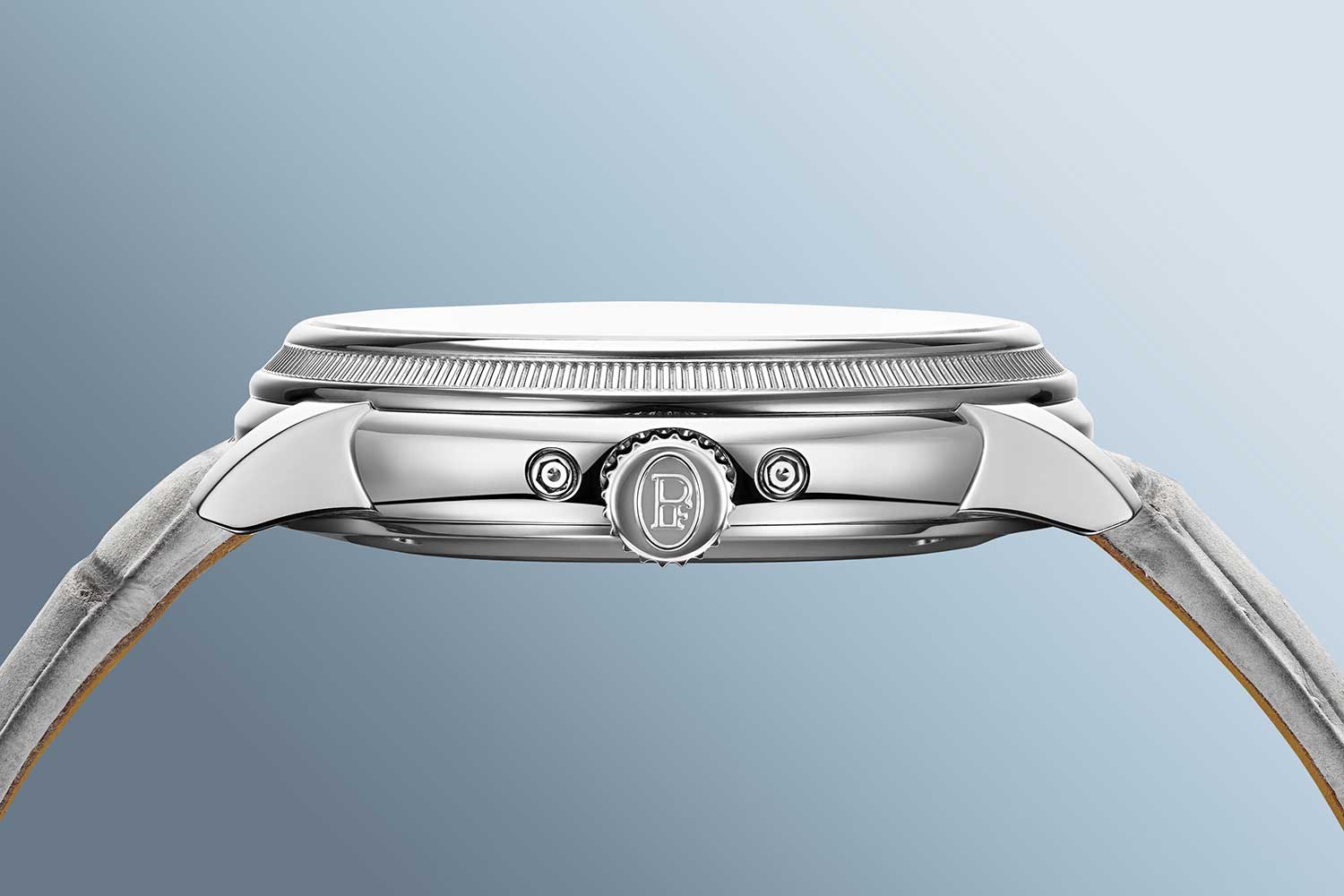
Measuring just 10.9mm high, the 40.6mm case keeps proportions perfectly balanced
It also explains why Parmigiani favors a pin buckle on an elegant watch. “When you put all that craft in the movement,” Terreni says, “you can’t look at it through the blade of a deployant.” If you prefer, you can buy the deployant as a spare; Parmigiani will never scold for prudence. But the house’s point of view is clear: the most luxurious solution is the one that best serves the craft.
The courage to edit
Anyone can add; it takes nerve to remove. Parmigiani’s recent movements express that courage in ways that feel both novel and inevitable. The Tonda PF GMT Rattrapante, for instance, reimagined the split seconds concept by translating it from chronograph to travel time. Home time is in gold; local time advances with a thumb-press at 8 o’clock; one gold pusher “catches up” the hands when you return. “Everything that separates you from home is white,” Terreni says. “Everything that unites you with home is gold.”
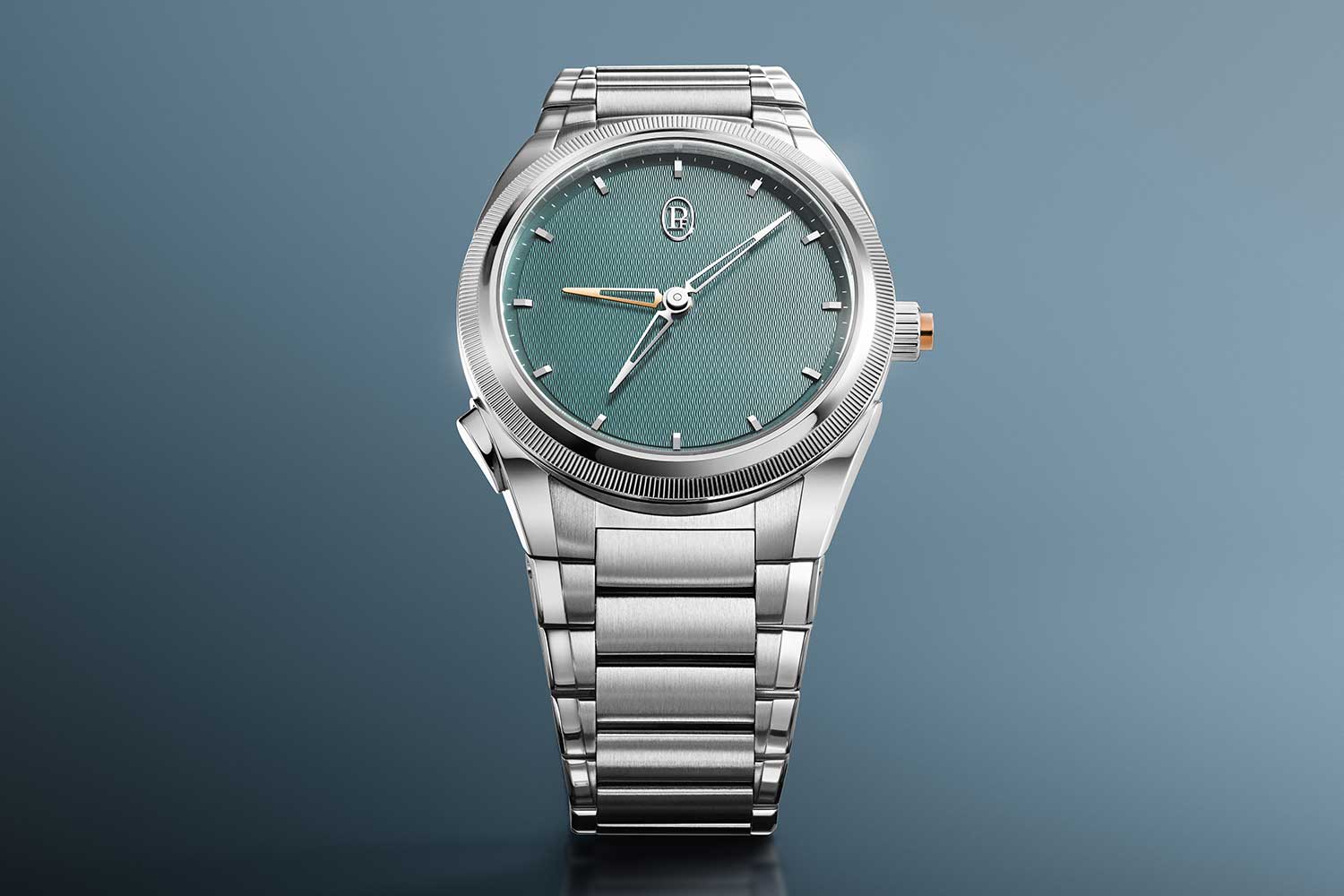
Tonda PF GMT Rattrapante
The idea for the Minute Rattrapante followed — an instrument for mastering your time by revealing, in a dial sector, how much remains for a self-assigned task. It is a small revolution in how a wristwatch can be helpful without becoming a gadget.
The Toric QP belongs to this same philosophy. Yes, it is classical. But its classicism is functional rather than decorative: the complication is simplified until its reading becomes self-evident. That clarity is not the absence of complexity; it is the conquest of it.
In terms of fit, Terreni is clear that for him case dimensions are the most abused numbers in watchmaking discourse; he prefers to talk about the fit. The Toric’s dial opening is 39mm, but the case measures 40.6mm because the flank is fuller than the bezel. The lugs are “extremely short” so that, on the wrist, the watch wears closer to 39mm than 41mm. “Comfort has nothing to do with the diameter,” he argues. “It has to do with the position of the lugs.”
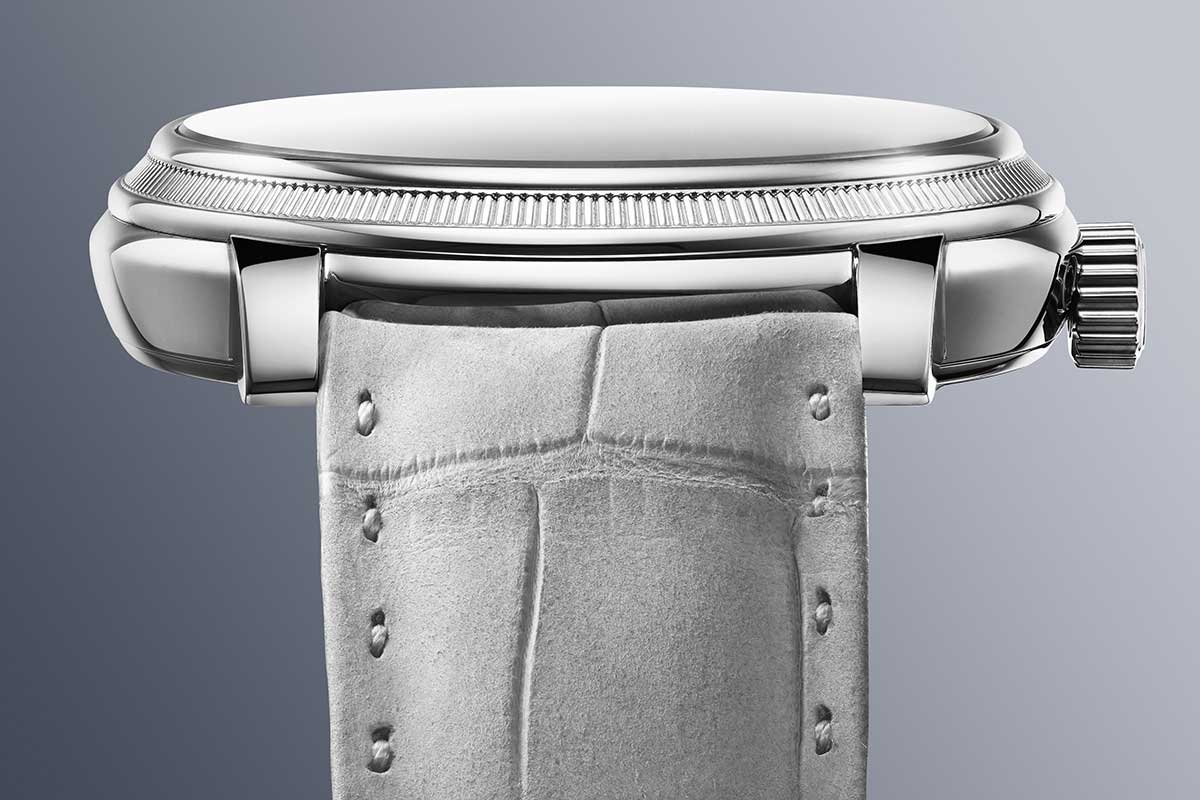
The analogy with tailoring is apt. Just as the hand knows a good shoulder from a poor one, the wrist knows a balanced watch immediately. Parmigiani leans into the tactile: a nubuck-treated strap that feels like silk, careful stitching borrowed from bespoke habits, pin buckle for grace and lightness. The goal is not to mimic vintage sizes or chase trends; it is to deliver the feeling of a garment cut for you.
Courtship over conquest
Terreni’s reset extends beyond product to the manner in which Parmigiani meets its audience. The brand has ruthlessly streamlined references and distribution alike, cutting two-thirds of its doors and adding only those partners who can properly court a connoisseur. “We are looking for a partner,” he says, “somebody to marry.” That means serious multi-brand retailers where a client can compare across maisons and speak with a salesperson who knows the field and knows the customer.
Today Parmigiani works with roughly 100 retailers worldwide, small enough for intimacy, large enough for reach. The result is the kind of community watch lovers actually want: dinners where owners talk about how a function works rather than how long they waited to buy it. “When people wear Parmigiani to gatherings,” Terreni smiles, “everyone ends up talking about Parmigiani. And the conversations are about watchmaking.”
As for where Parmigiani sits in haute horlogerie’s current landscape, the brand occupies a narrow, elevated ridge between the global maisons and the cult independents. Collectors who buy A. Lange and Söhne, Patek Philippe or Audemars Piguet happily wear Parmigiani; those who treasure Kari Voutilainen or Romain Gauthier often do as well. What Parmigiani offers that few others can is the blend of manufacture seriousness, artisanal finishing and design serenity — pieces that feel as if they were built for your own private audience.
There is mutual respect across that ridge. Terreni notes with warmth that peers at other top houses see Parmigiani as a reference point for integrity. In a market where novelty is constant and attention is fickle, a brand that protects its simplicity can feel radical.
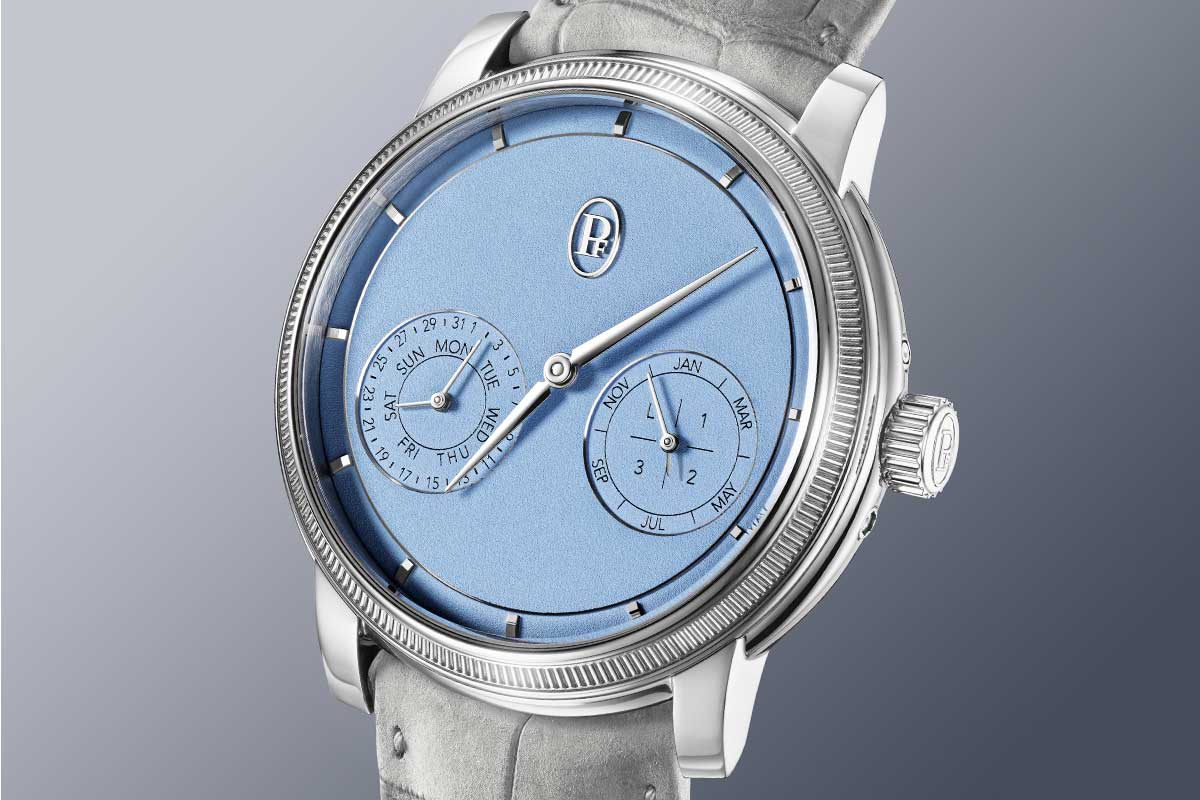
Toric Quantième Perpétuel “Morning Blue”
Living with a legend
Michel Parmigiani remains the house’s honorary president. His presence is more spiritual than operational, yet his influence is everywhere. Terreni describes visits with the founder not as masterclasses but as conversations in which wisdom appears like a glint on a mirror-polished bevel. You have to notice it. “You can’t ask him for the 10 most important things he learned in life,” he says. “You speak, he tells stories, and you must pick up the important things.”
Sometimes the teaching is concrete, like his argument for pin buckles or his suggestion of grené main for the Toric’s dial. Sometimes it is a way of holding an object. Terreni recalls watching the master open an extraordinary pocket watch in the office, every gesture measured and certain. “We were all shy to touch it,” he laughs. “He was the boss. The master.” Then the founder performed a quality check on the chain: held taut, then dropped with a diver’s grace to land in a small, perfect coil. “The smaller the surface when it finishes falling, the more flexible the chain is,” Terreni explains, still admiring. “And that chain fell on itself perfectly.”
It is a good image for the brand itself: a long chain of knowledge, allowed to fall into the smallest possible surface. Flexibility without noise. Perfection without performance.
The Toric QP is not trying to be the last word in calendar complexity, nor the first word in spectacle. It is trying to be exactly what Parmigiani believes a watch should be in 2025: an object of private satisfaction whose excellence is legible to those who know where to look. The gold case is not a banner; it is a conductor of light. The gold dial is not an extravagance; it is the natural substrate for a handmade finish. The calendar is not for show; it is a service rendered with discretion.
Terreni is clear-eyed about the commercial courage this requires. Gold prices have nearly doubled since the project began, but Parmigiani will not ask clients to subsidize speculation. “It is expensive because of the craft,” he says without apology. “We cannot reverse on the customer the speculation of the metal.” That, too, is private luxury: the refusal to let noise contaminate value.
What, finally, does the Toric QP say about Parmigiani’s place in the industry? It says that the brand has decided to pursue an older, harder form of prestige — the one that trusts the owner’s taste more than the crowd’s gaze. It says that finishing still matters, that a dial brushed by hand can move you, that the most modern thing a dress watch can do is behave with impeccable manners. It says that if you fell for the secret pleasures and clever innovations of Tonda PF and you now crave a watch that salutes the past but looks to the future, you have found it in the Toric QP. “Luxury is so vast and so beautiful,” Terreni says, “and our way of expressing it is this.”
Tech Specs: Parmigiani Fleurier Toric Perpetual Calendar
Reference: PFH952-2010002-300181 (platinum); PFH952-2010001-300181 (rose gold)
Movement: Manual winding Caliber PF733; 60-hour power reserve
Functions: Hours, minutes and perpetual calendar
Case: 40.6mm × 10.9mm; platinum or 18K rose gold; water resistant to 30m
Dial: Golden Hour or Morning Blue with hand-grained matte finish; hand-applied gold hour markers
Strap: Akoya or Arctic Gray nubuck alligator leather; platinum or 18K rose gold pin buckle
Price: CHF 92,000 (platinum); CHF 85,000 (rose gold)
Availability: Limited edition of 50 pieces in each metal
Parmigiani Fleurier
You may also like
Editorial
Parmigiani Marks Founder’s Birthday with La Ravenale Minute Repeater
Dec 5, 2025
Editorial
Parmigiani Marks Founder’s Birthday with La Ravenale Minute Repeater
Dec 5, 2025
Reviews
A Closer Look: Parmigiani Fleurier Toric Perpetual Calendar
Aug 12, 2025
Reviews
A Closer Look: Parmigiani Fleurier Toric Perpetual Calendar
Aug 12, 2025
News
The New Parmigiani Fleurier Tonda PF Sport Chronograph In Rose Gold Sandstone
Jul 17, 2025
News
The New Parmigiani Fleurier Tonda PF Sport Chronograph In Rose Gold Sandstone
Jul 17, 2025