
A Closer Look: Vacheron Constantin Les Cabinotiers Solaria Ultra Grand Complication
Reviews
A Closer Look: Vacheron Constantin Les Cabinotiers Solaria Ultra Grand Complication

The Berkley Grand Complication, introduced by Vacheron Constantin at Watches & Wonders last year with its 61 complications, set the record as the most complicated watch ever made. More than that, it did something supremely difficult which was to encode the cycles of the Chinese traditional lunisolar calendar into a perpetual calendar that requires no correction until the year 2200.
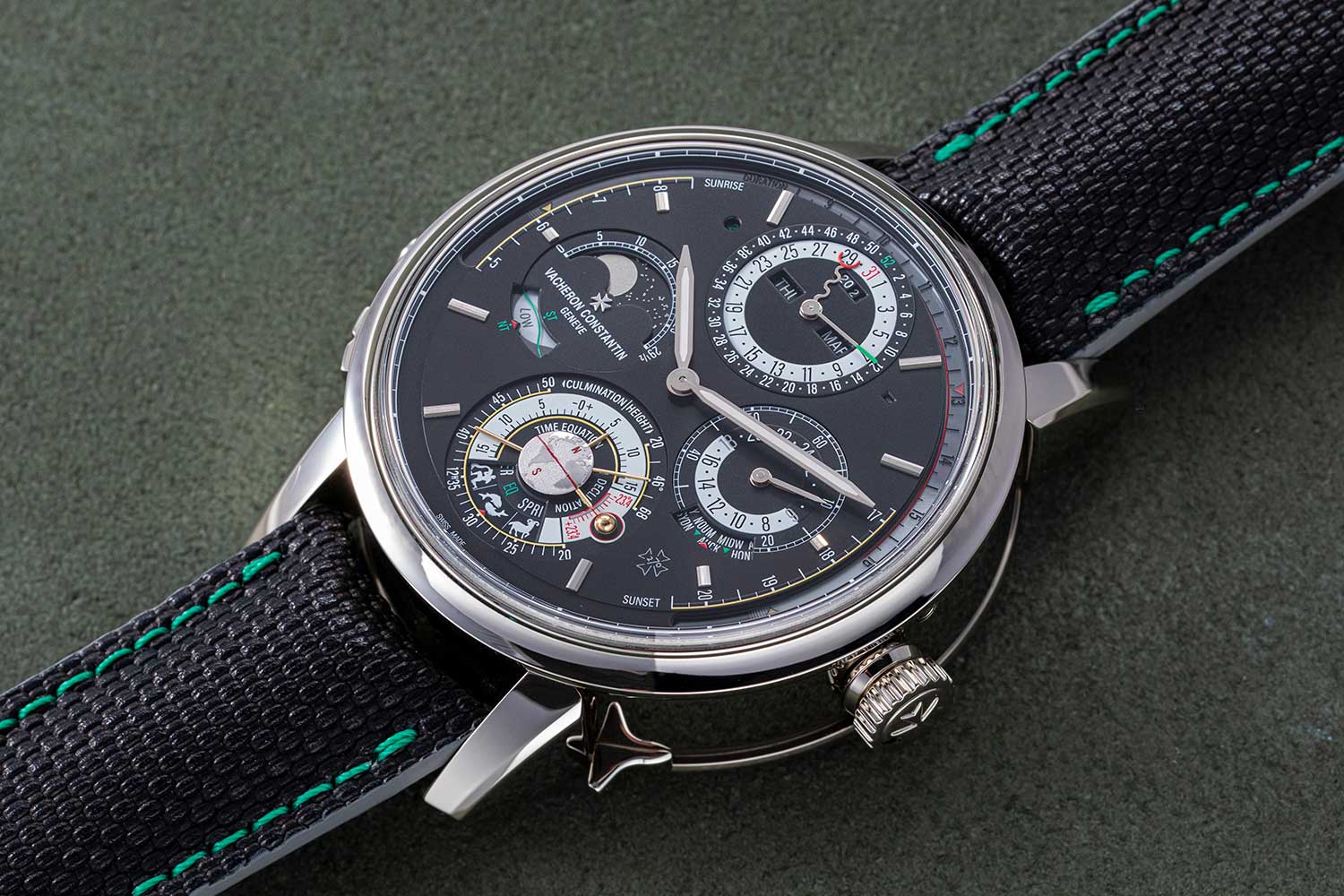
To mark its 270th anniversary this year, Vacheron Constantin has followed up with the world’s most complicated wristwatch — the Les Cabinotiers Solaria Ultra Grand Complication, featuring a total of 41 complications. Besides its sheer complexity, the watch is unique among highly complicated timepieces in that, alongside traditional complications such as a minute repeater with Westminster chimes, perpetual calendar, split-seconds chronograph, and tourbillon, it has an unusually high concentration of finer and very exotic astronomical complications, specifically charting the apparent course of the Sun across the sky — its position, height, culmination, and even its declination, hence its name, Solaria. Most extraordinarily, the split-seconds chronograph can be used in conjunction with a celestial chart, allowing the wearer to calculate when a selected star or constellation will appear in the sky — a first in watchmaking.
Vacheron Constantin Les Cabinotiers Solaria Ultra Grand Complication (Revolution©)
Oftentimes, the industry tends to glorify complexity as if it were an end in itself but this is a grand complication with a focus and a goal, which is what makes complications, if not mechanical watchmaking at large, compelling. Apart from its comprehensiveness as an astronomical watch, this is apparent when you realise the watch measures 45mm in diameter and 14.99mm thick, which is about the size of some chronographs. Additionally, where the dial compositions of many complicated watches can appear disjointed or overwhelmed by their own functionality, the Solaria remains visually balanced and well-resolved. Each indication is carefully integrated, with spatial relationships and visual hierarchy thoughtfully managed to support clarity. The outcome is a rare combination of technical richness and aesthetic restraint.
-
- Vacheron Constantin Les Cabinotiers Solaria Ultra Grand Complication (Revolution©)
-

- Vacheron Constantin Les Cabinotiers Solaria Ultra Grand Complication (Revolution©)
Solar Mechanics
The Solaria is a double-sided watch, with its complications organised logically across both dials. The different indications are rooted in just three basic timekeeping systems: mean solar time (civil time), apparent solar time (actual position of the Sun in the sky as seen from a specific location on Earth), and sidereal time (the rotation of the Earth relative to distant stars). Mean solar time is based on the average motion of the Sun across the sky, smoothing out the irregularities caused by the elliptical orbit of the Earth and axial tilt, and serves as the basis for the standard 24-hour day used in clocks and calendars. Apparent solar time, on the other hand, reflects the actual position of the Sun in the sky at a given location, which is what sundials indicate, and varies throughout the year. This variation arises because the orbit of the Earth around the Sun is not perfectly circular but elliptical, causing the planet to move faster when it is closer to the Sun and slower when it is farther away. Additionally, the Earth’s axis is tilted about 23.5° relative to its orbital plane, so the apparent daily motion of the Sun across the sky changes angle throughout the year. Together, these two factors lead to apparent solar days that fluctuate slightly in duration, differing from the constant length of the mean solar day by as much as approximately ±15 minutes. This difference between apparent and mean solar time is precisely quantified by the equation of time.
Sidereal time operates on a completely different principle. It measures the rotation of the Earth relative to distant stars rather than the Sun with the vernal equinox serving as the reference point. Because the Earth is simultaneously orbiting the Sun while rotating on its axis, it must rotate slightly more than 360 degrees for the Sun to return to the same position in the sky, making a solar day approximately 23 hours, 56 minutes, and 4.1 seconds of sidereal time. As a result, a sidereal day is about four minutes shorter than a mean solar day.
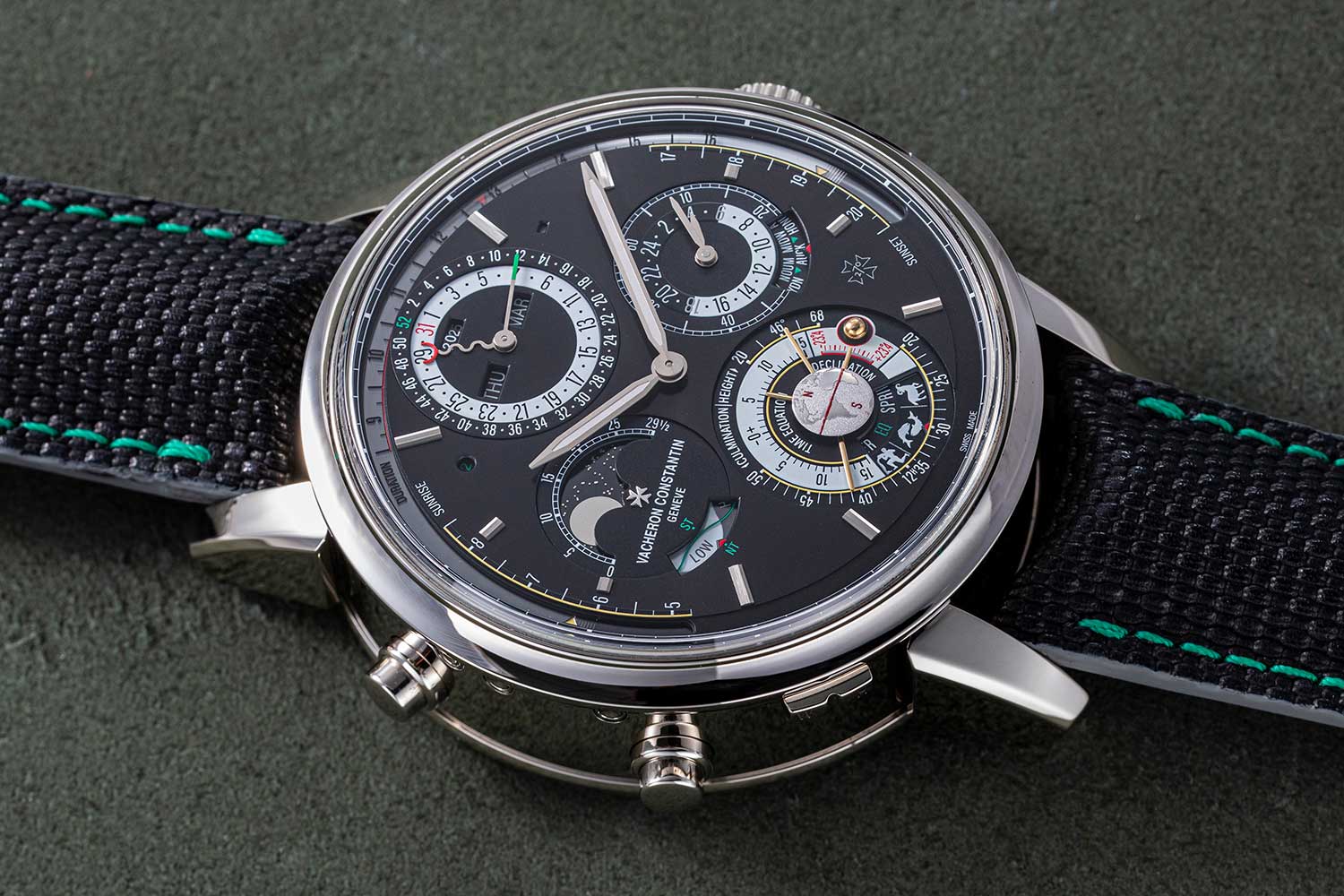
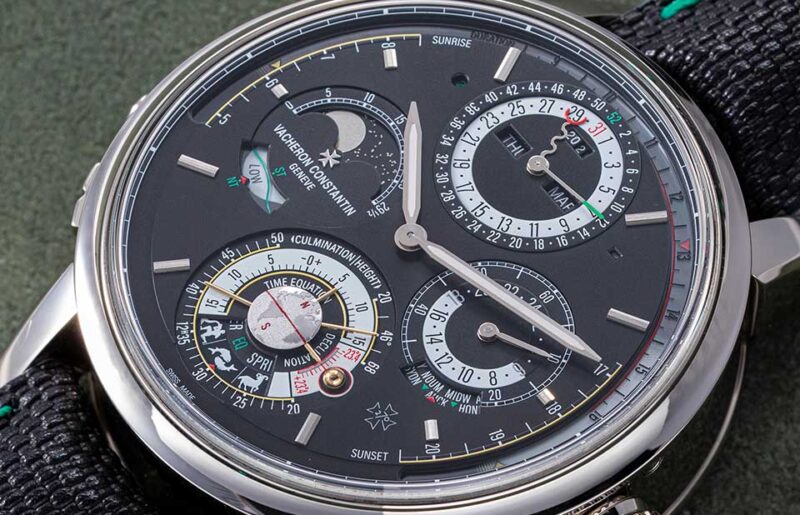
On the front of the watch, civil time is indicated by central hour and minute hands, while the second time zone along with a day and night indicator and world time are placed at three o’clock, with the latter shown on a rotating disc bearing the names of 24 cities. At twelve o’clock sits the perpetual calendar, which incorporates not just the date, day and month but also a four-digit year display, the ISO 8601 week number via a peripheral hand as well as the leap year in a small aperture next to the counter on the right. At nine o’clock is a beautifully executed moon phase display, under which lies a mareoscope, a rare complication showing the occurrence of spring and neap tides. These tidal extremes follow a 14.76-day cycle and occur twice each lunar month, due to the gravitational alignment of the Moon and Sun. Spring tides, when the Sun and Moon align, produce higher and lower tides than average, while neap tides, occurring when the Sun and Moon are at right angles, result in milder tidal ranges.
Vacheron Constantin Les Cabinotiers Solaria Ultra Grand Complication (Revolution©)
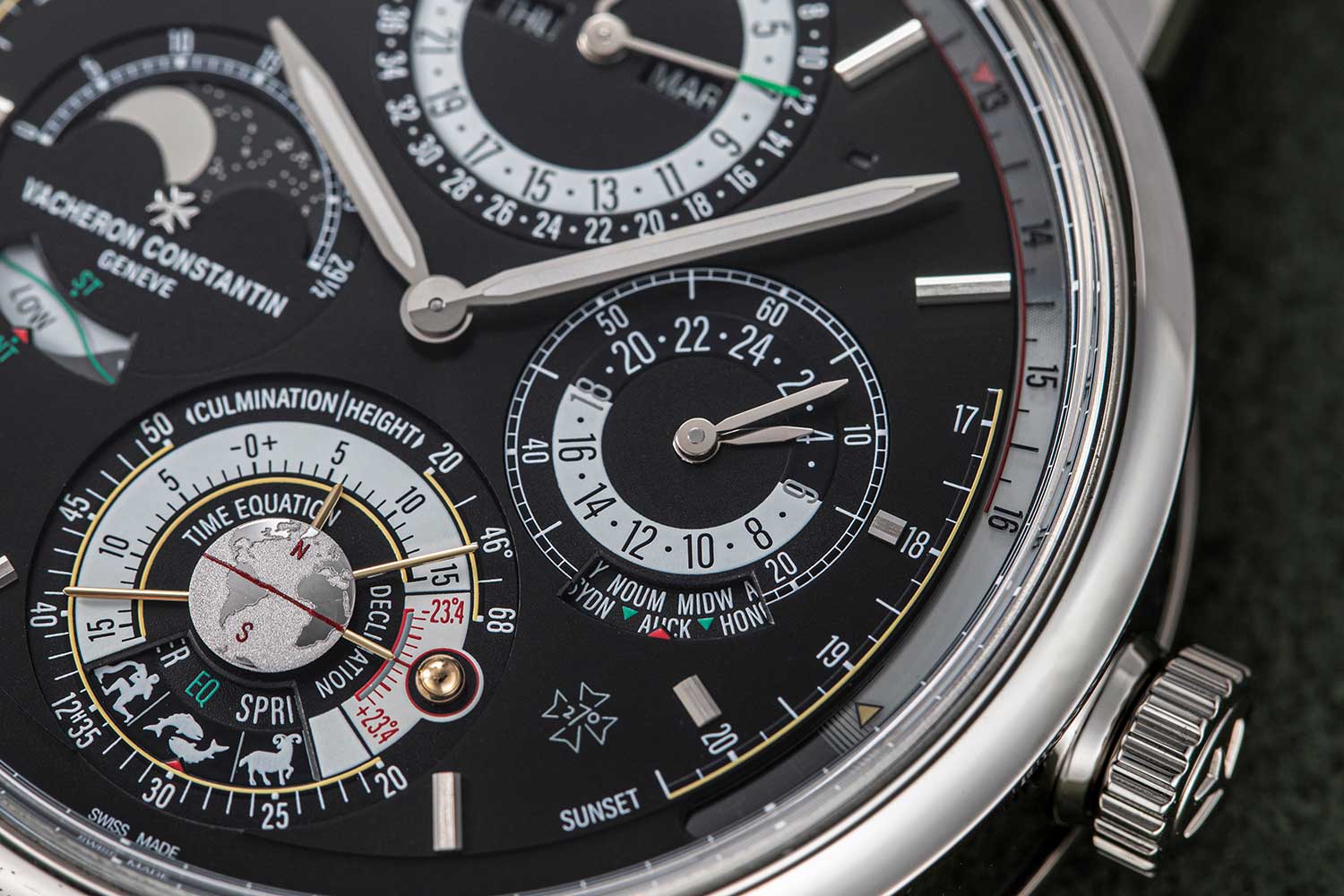
The thematic focus of the watch, the entire solar complication cluster is concentrated at six o’clock. These include the height of the Sun above the horizon which varies throughout the year depending on the Earth’s axial tilt; solar culmination, which marks the precise moment of solar noon when the Sun reaches its highest point in the sky; the declination of the Sun, which is the seasonal shift of its apparent path as it oscillates between the Tropics of Cancer and Capricorn; and the Equation of Time, which shows the difference between mean solar time and apparent solar time, expressed on a scale of approximately ±15 minutes.
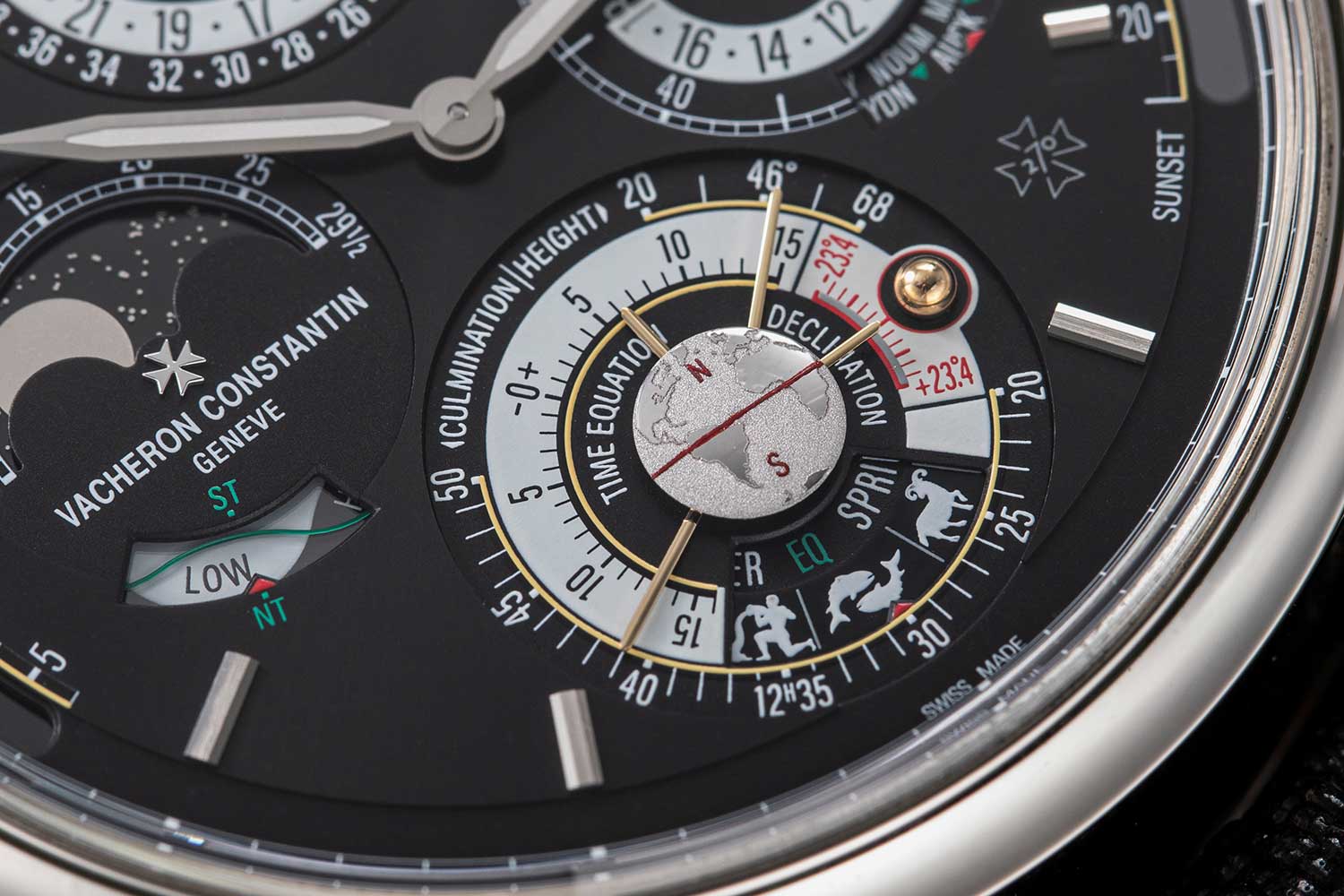
Vacheron Constantin Les Cabinotiers Solaria Ultra Grand Complication (Revolution©)
This solar display also incorporates a rotating disc that charts the annual passage of the Sun through thirteen constellations of the zodiac, as well as the solstices (the longest and shortest days in winter and summer), equinoxes (the twice-yearly occurrence when day and night are the same length everywhere on Earth), and the four seasons. Anchoring the display is a 5mm Earth dome in rhodium-plated gold, with polished continents and sandblasted oceans. As the globe rotates, the position of the Sun represented by a small gold sphere relative to the equator on the globe indicates the solar declination – northward toward the Tropic of Cancer in summer, southward toward the Tropic of Capricorn in winter.
Encircling the entire dial is a sapphire ring that indicates the Sun’s position in the sky, marked by a yellow dot, along with sunrise and sunset times and the length of daylight. Like the culmination and height of the Sun, the times for sunset and sunrise, as well as the duration of the day, are mechanically calibrated to a specific latitude, dependent on the point on Earth where the viewer is located.
Star-spotting Split Seconds Chronograph
The reverse side of the watch is devoted to the star chart and the split seconds chronograph with sidereal time serving as the backbone to the system. The star chart is printed on a smoked sapphire disc and rotates once per full revolution in a sidereal day (approx. 23h 56m 4s). The star chart is actually composed of two discs. The upper disc that carries the star map is fixed, and the lower rotates once per sidereal day and carries a partially opaque dark grey ellipse against which the stars currently above the horizon are shown. The yellow and white ellipses indicate the positions of the plane of the ecliptic and the celestial equator.
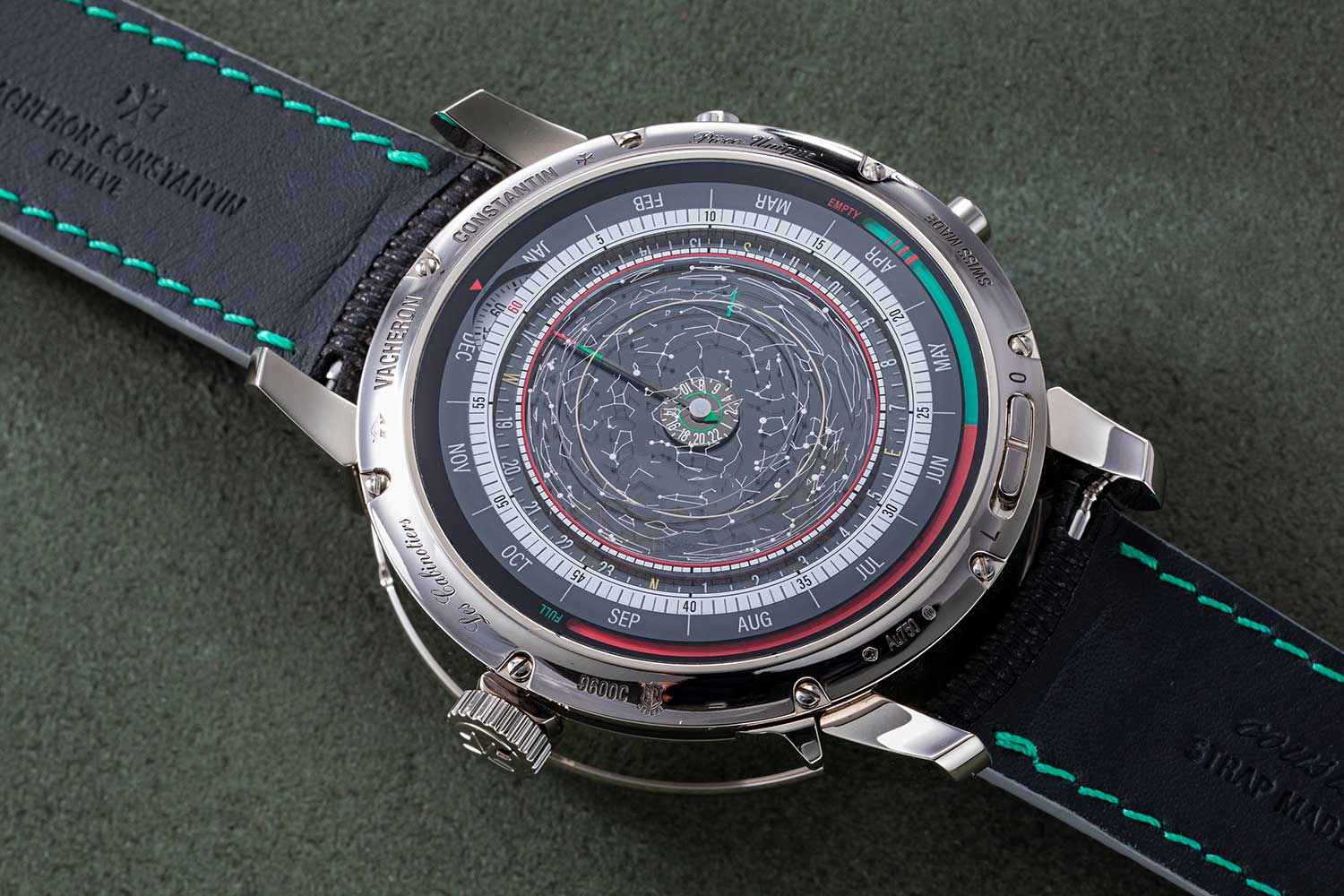
Vacheron Constantin Les Cabinotiers Solaria Ultra Grand Complication (Revolution©)
The same sidereal rotation that measures sidereal time also elegantly doubles as an annual month indicator. This dual-purpose indication is made possible because a sidereal day is approximately four minutes shorter than a civil day. The smoked sapphire disc features an “N” marker indicating celestial North, serving as the zero-hour reference for sidereal midnight. As a result, at civil midnight each night, the sidereal disc will have advanced roughly four minutes relative to its position the previous night, causing the “N” marker to slowly shift position in relation to the fixed outer month scale. Over the course of a full year, this incremental daily shift accumulates to exactly one full rotation around the month ring. Therefore, by observing the position of the “N” marker against the fixed month ring at exactly civil midnight, the current month of the year can be read. This approach leverages the subtle yet consistent daily difference between sidereal and civil time, allowing the watch to indicate both sidereal time and the current month using just a single rotating disc, without additional gearing.
Complementing the astronomical indications on the reverse side is a split-seconds chronograph with two extremely fine superimposed hands lacquered in red and green. The chronograph minutes are indicated clearly with a red arrow on a dedicated 60-minute rotating counter positioned at 12 o’clock, distinct from the sidereal indications, ensuring clarity. What’s vastly unique is that the chronograph here can be used as a tool for astronomical anticipation, not just athletic timing.
At the very center of the dial is a small rotating disc that indicates the number of hours (1 to 22) remaining before a selected star will appear in the observer’s optimal viewing position. The process begins by visually selecting a specific star on the rotating star map. A green reference index on the grey ellipse marks the point of culmination, where celestial objects cross the local meridian at their highest altitude. In its default configuration, calibrated for Geneva, this index corresponds to due south.
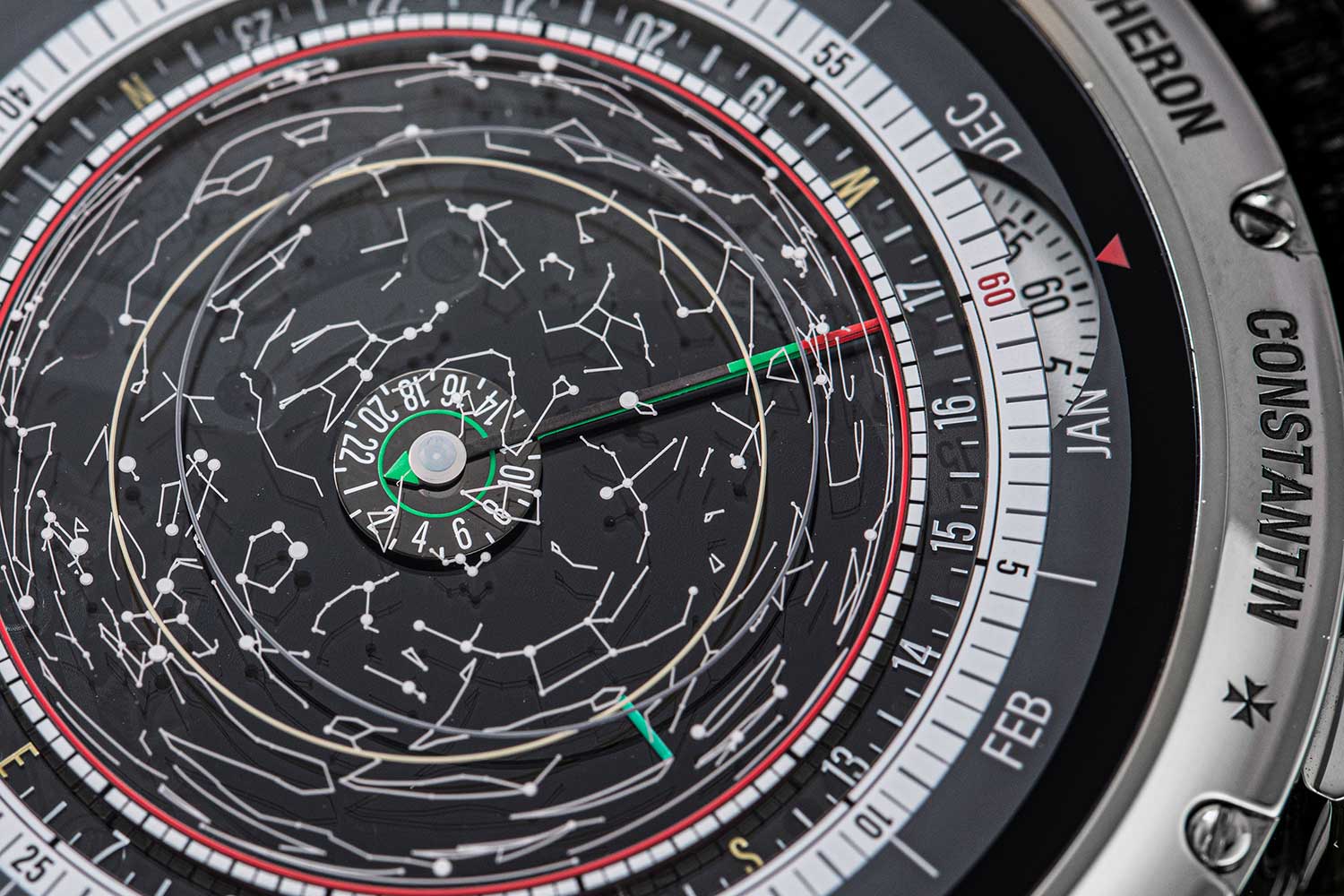
Vacheron Constantin Les Cabinotiers Solaria Ultra Grand Complication (Revolution©)
Once the star is identified for tracking, the wearer then activates the split-seconds chronograph and when the chronograph hand reaches the green index on the grey ellipse, the wearer stops the first chronograph hand but lets the second hand continue until it aligns exactly with the current position of the selected star. The angular separation between the two chronograph hands then represents the time interval, measured in sidereal hours, until the selected celestial object will reach its point of culmination. This interval is indicated by a small 22-hour disc at the centre of the dial, which is directly coupled to the split-seconds mechanism and displays the elapsed sidereal time.
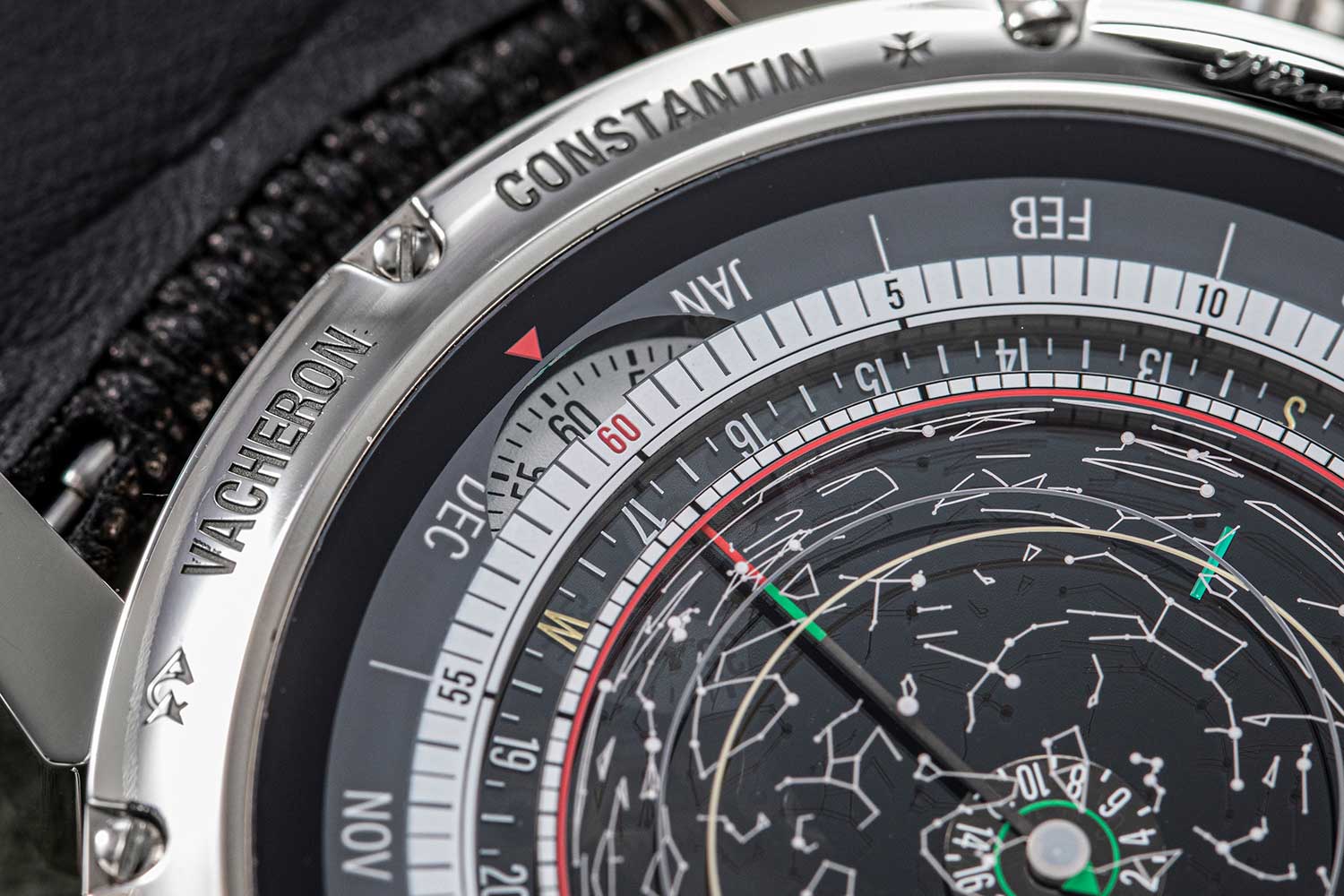
Vacheron Constantin Les Cabinotiers Solaria Ultra Grand Complication (Revolution©)
This is a rare convergence of predictive astronomical modelling and traditional mechanics. It brings a deeper level of interactivity and usefulness to the sky chart complication, allowing the user not just to know what is currently above the horizon, but also to plan observations and track celestial motion over time.
Construction of the Calibre 3655
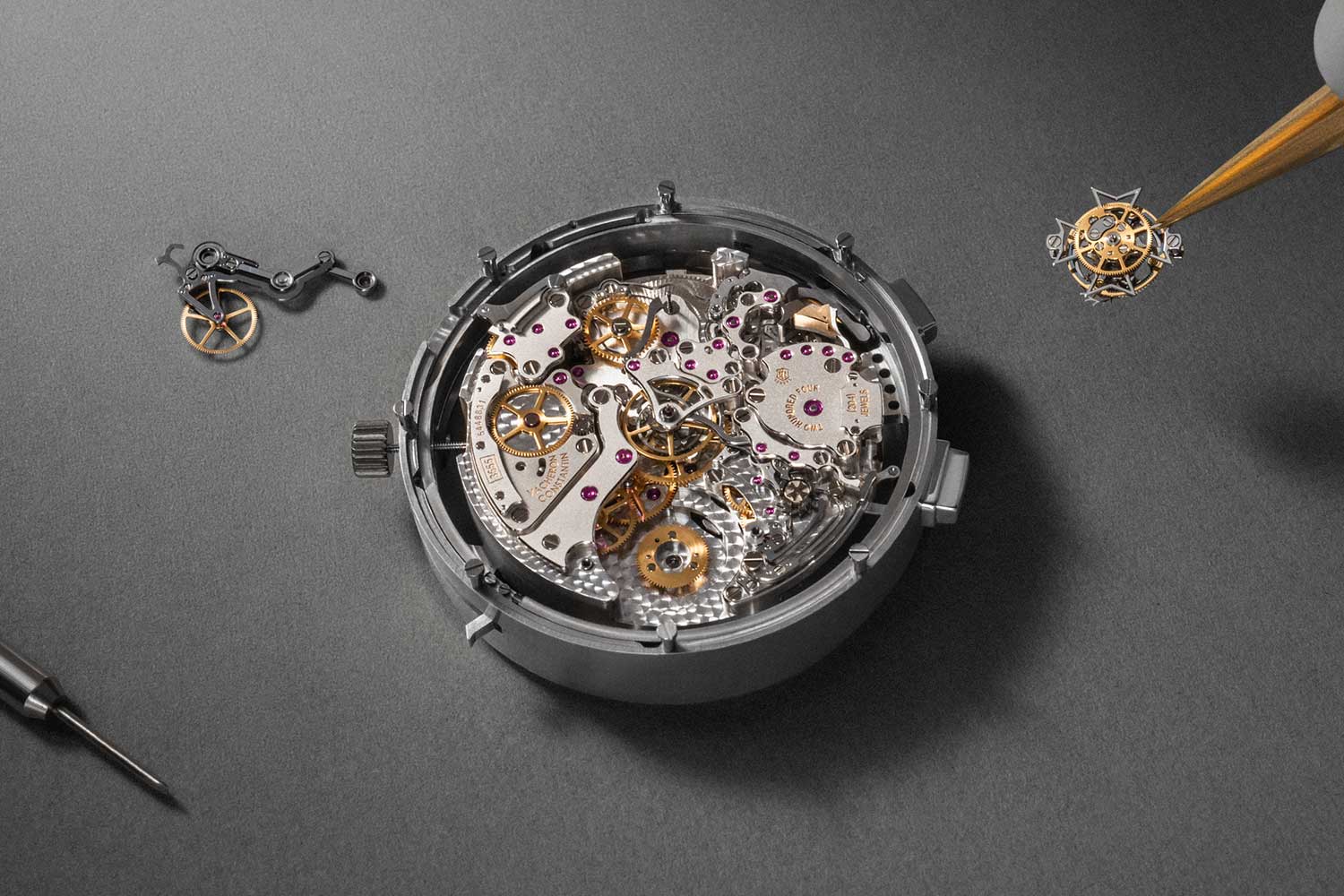
What’s particularly remarkable is that the entire movement and case were the work of a single watchmaker. Unlike the Reference 57260 and The Berkley Grand Complication, each of which required a team of three watchmakers over eight years, the Solaria was conceived and developed by one individual by the name of Jean-Marie Bouquin, who was also behind the highly complicated Celestia in 2017. Over the course of eight years, he single-handedly designed both the movement and the case. With a record-setting 41 complications, the Calibre 3655 consists of a staggering 1521 components and 204 jewels, and is protected by no fewer than 13 patent applications covering both its architecture and specific mechanisms. It measures 36mm diameter and 10.96mm thick, and has a power reserve of 72 hours and a frequency of 21,600vph.
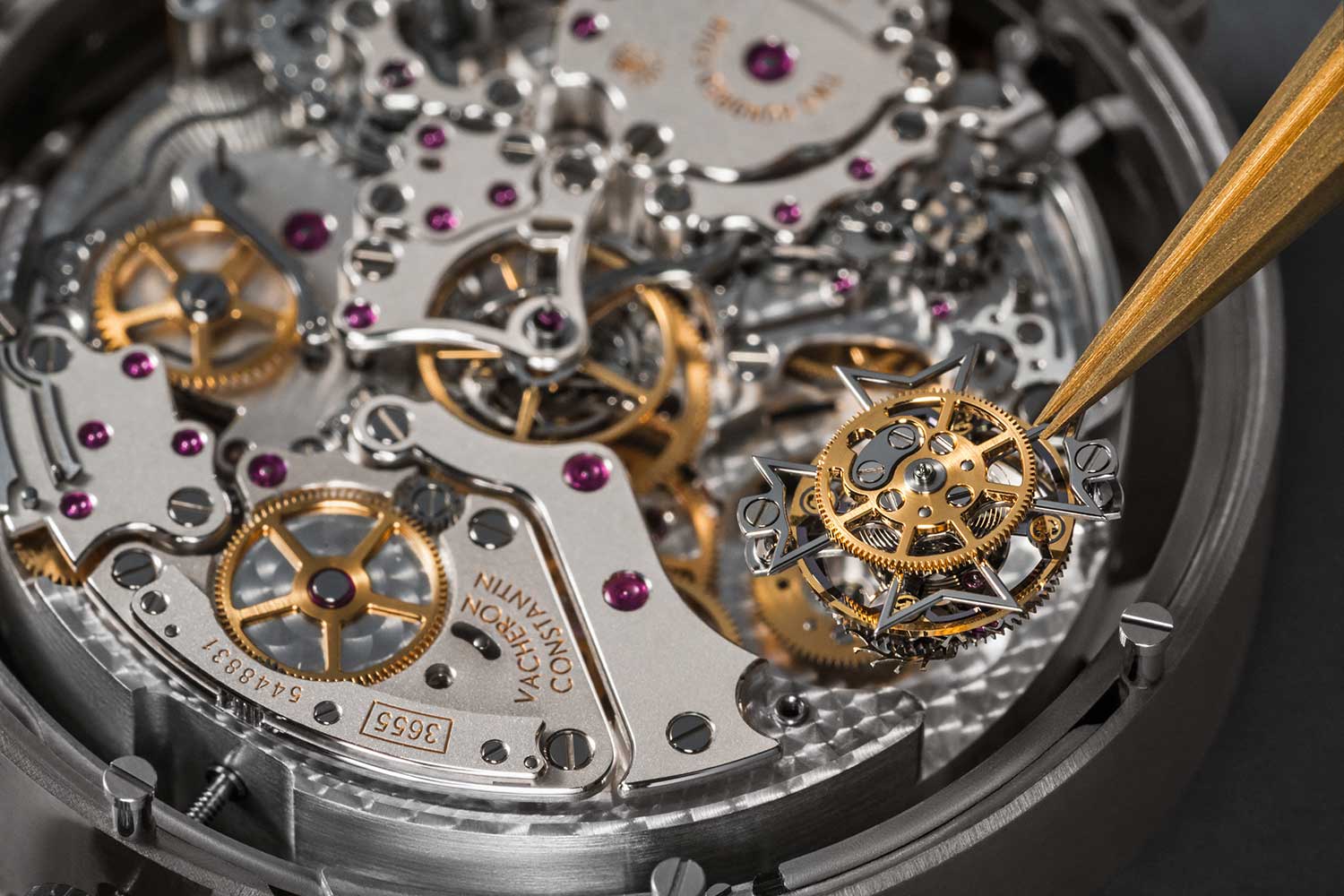
Calibre 3655
The Calibre 3655 has a particularly ingenious and highly serviceable construction. As is convention, the chronograph is fitted to the top plate and the repeating work on the bottom plate while the astronomical module is fitted to a separate plate that is screwed to the base movement under the dial. What’s unusual is that the astronomical module is removable as a complete sub-assembly without having to first remove the hands and the dial. The relative positions of the perpetual calendar and astronomical indications are preserved thanks to a keyed coaxial coupling that ensures a unique angular engagement between the module and the base movement.
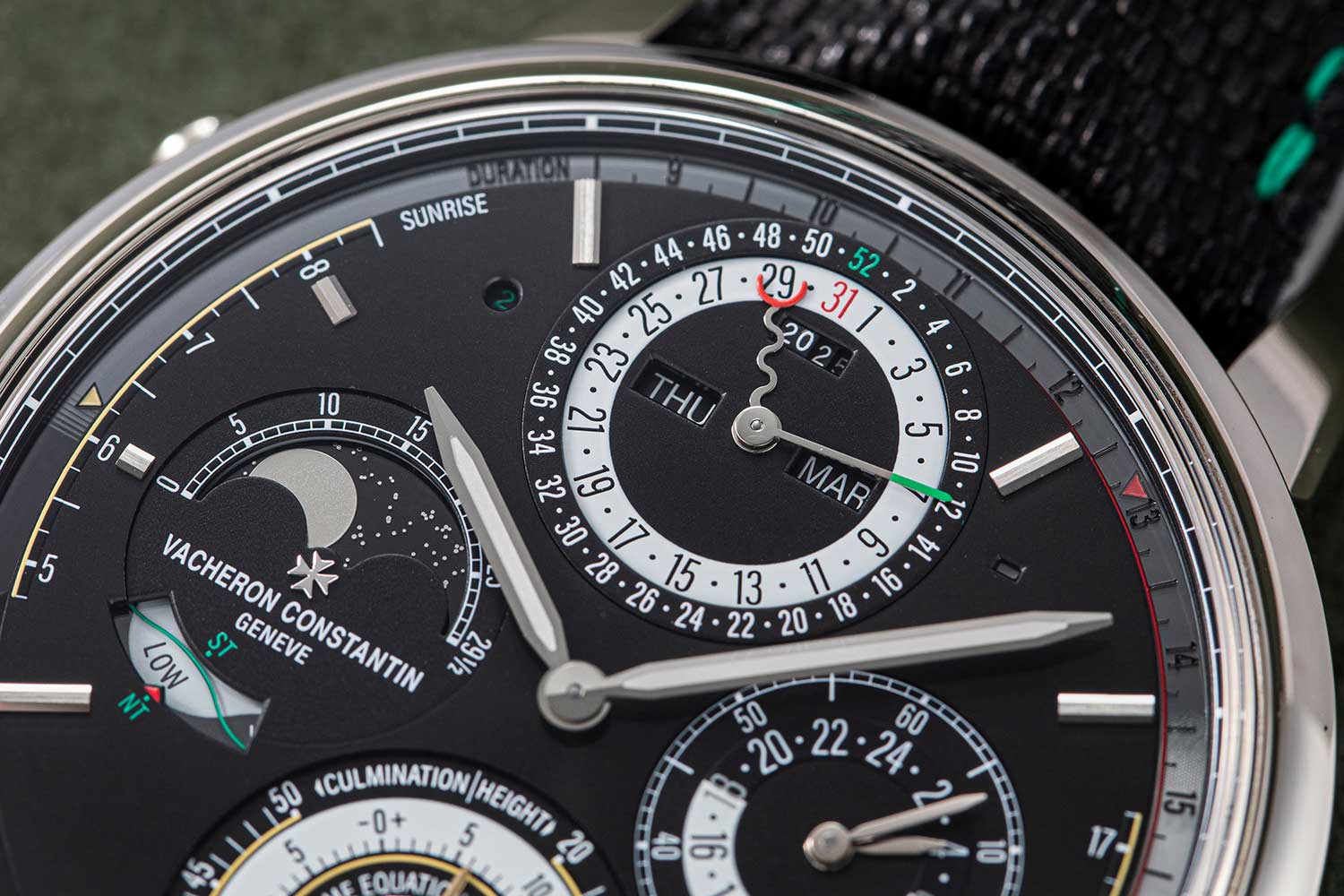
Vacheron Constantin Les Cabinotiers Solaria Ultra Grand Complication (Revolution©)
This coupling interface consists of two asymmetrical pins located on the underside of the module, which engage with a notched receptacle on the base movement. Their specific geometry permits assembly in only one angular position, mechanically locking the phasing between the minute hand and all associated astronomical displays, including solar declination, the equation of time and sidereal time. As a result, the module can be detached and reinstalled without removing the hands or dial, and without compromising the positional integrity of any complication. This approach not only reduces service complexity but also reflects a deeper architectural philosophy in which mechanical sophistication and practical maintainability are treated as complementary rather than conflicting objectives.
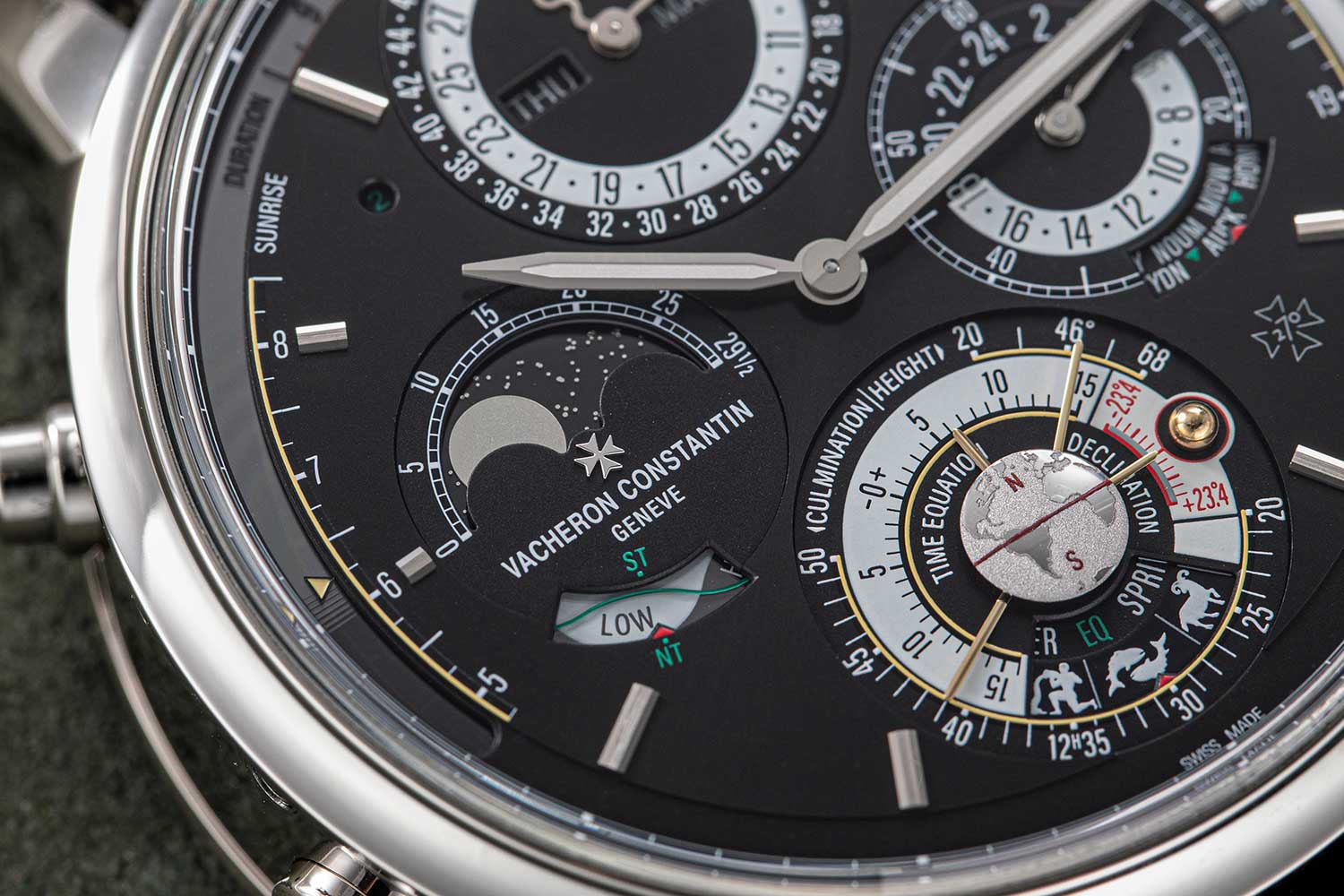
Vacheron Constantin Les Cabinotiers Solaria Ultra Grand Complication (Revolution©)
Additionally, the module has an ultra-thin construction measuring just 2.8mm thick. While cams are commonly used for complications that involve non-linear or cyclic variation, such as the equation of time, sunrise/sunset times, or solar elevation, they are integrated into a single ultra-thin cam in the form of a two-sided, monobloc wheel. Instead of stacking multiple cam discs – each adding height to the mechanism – this solution engraves individual closed-loop grooves onto both faces of a single rotating plate. Each groove acts as a cam profile for a feeler arm, driving a corresponding display on the dial side. The result is a mechanically sophisticated module capable of delivering four independent astronomical indications with virtually no increase in vertical footprint.
On the dial-side face of the cam wheel, the first groove governs the solar elevation, encoding the Sun’s apparent height in the sky over the course of a tropical year, while the second groove traces the equation of time, capturing the fluctuating difference between mean solar time and apparent solar time. On the underside, two additional grooves are machined, one maps the annual variation of sunrise times, and the other of sunset times, each shaped according to the location for which the indications are calibrated. Despite the complexity of encoding four independent annual cycles, the use of a single rotating disc, rather than a stacked cam assembly, ensures that the overall module remains remarkably thin, compact, and highly integrated.
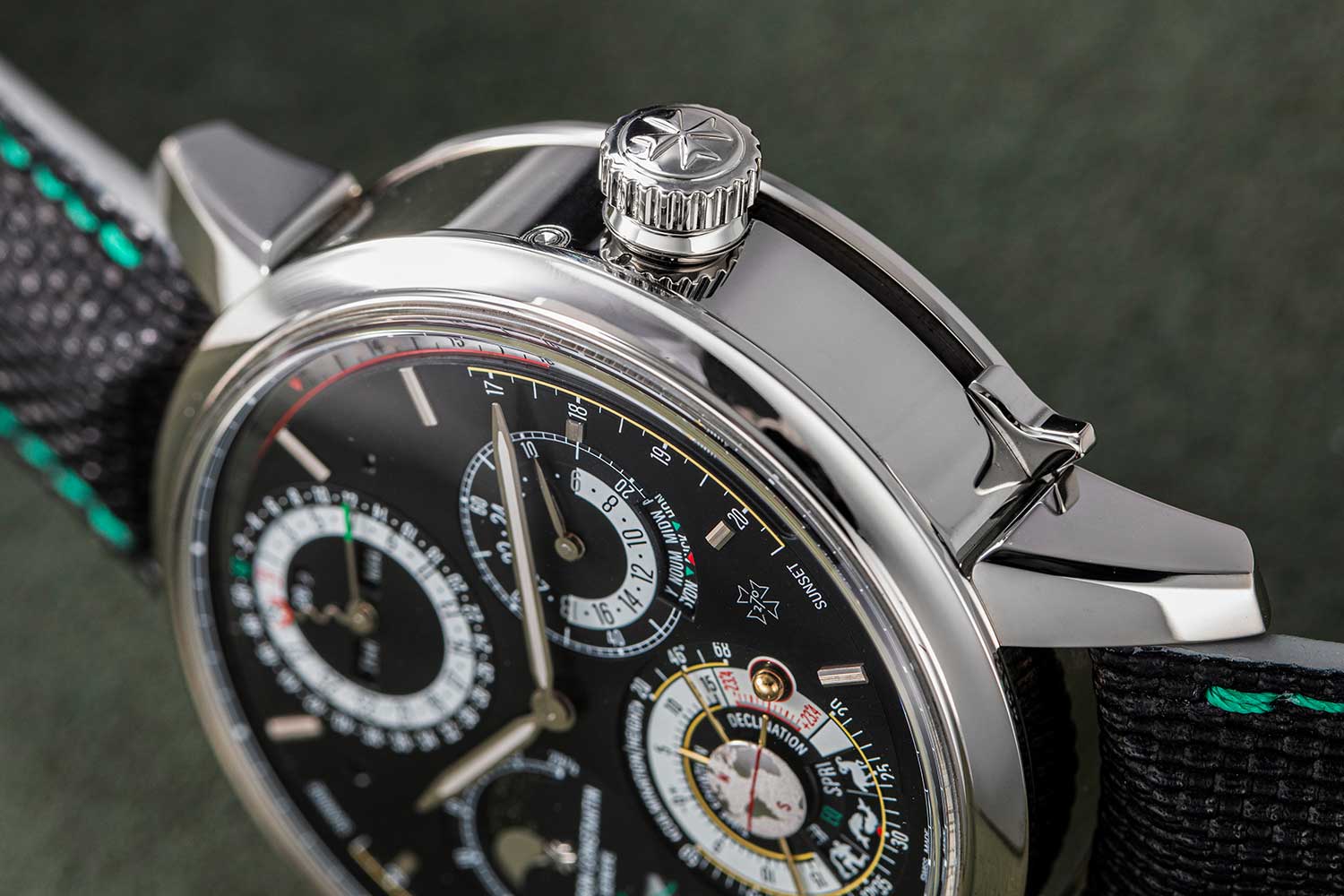
Vacheron Constantin Les Cabinotiers Solaria Ultra Grand Complication (Revolution©)
At the same time, a very compact system enables local time to be adjusted independently of home time without using a conventional spring. Instead, it employs a differential gear train with one input connected to the going train and another to a correction mechanism incorporating a brake. During normal operation, a friction-mounted intermediate wheel transmits motion from the going train to the differential, keeping both hour hands in sync. But when the correction lever is actuated, the brake locks the primary input, allowing the second input to rotate the differential output. This shifts the local hour hand in discrete one-hour steps while simultaneously advancing the city disc, eliminating the need to calculate offsets or make sequential corrections. Once released, the brake disengages, the friction wheel reconnects seamlessly, and synchronised motion resumes.
Traditional Complications Executed Differently
The split seconds chronograph isn’t just unique in its application, it is also mechanically sophisticated. The chronograph tube and the split-seconds shaft are no longer loosely nested components but form a precisely aligned coaxial assembly. Both are pivoted at opposite ends – one in the chronograph bridge on the dial side and the other in the rattrapante bridge on the movement side – ensuring concentricity and stability.
Crucially, two intermediate bearings inside the chronograph tube maintain perfect alignment between the shaft and the tube, eliminating any tilt or friction that could disturb the motion of the hands. This guidance system ensures the split-seconds hand remains perfectly superimposed on the chronograph hand during normal operation and resets smoothly after being stopped.
Vacheron Constantin Les Cabinotiers Solaria Ultra Grand Complication (Revolution©)
Additionally, the chronograph mechanism also incorporates an isolator, which eliminates parasitic drag on the chronograph train caused by the drive lever of the split wheel dragging over its heart cam when the split hand is stopped. It consists of an additional wheel which sits above the split wheel and has a post on it that pushes the drive lever away from the heart cam completely when the split is activated.
The last complication, which takes up the bulk of the patents – 7 out of the 13 – is the minute repeater. It uses four gongs and four hammers, allowing it to play the Westminster carillon, the most complex chiming sequence in watchmaking. The hammers have been made smaller but heavier; three out of four of them are steel with added gold to increase their moment of inertia without increasing size. They are also positioned to ensure a perpendicular strike. The gongs are rectangular in section for added stiffness and resonance, and are attached to the middle case, which enhances acoustic performance by isolating vibrations from the dense movement.
Calibre 3655
Unusually, it has a function selector, more commonly seen in grand sonneries. This mode selector enables the wearer to switch between chiming the hours only or activating the full Westminster sequence.
Rather than relying on a traditional rocker and jumper spring, which takes up considerable space and exerts continuous radial pressure on the movement, the Solaria employs an ingenious bistable selector mechanism. The selector consists of a carriage that slides along the periphery of the movement, guided by two oblong slots that engage with fixed positioning pins. At either end of the carriage are elastically deformable clamps and housings that generate a precise locking force. The feel of the action is balanced and smooth in both directions – something conventional jumpers often struggle to achieve.
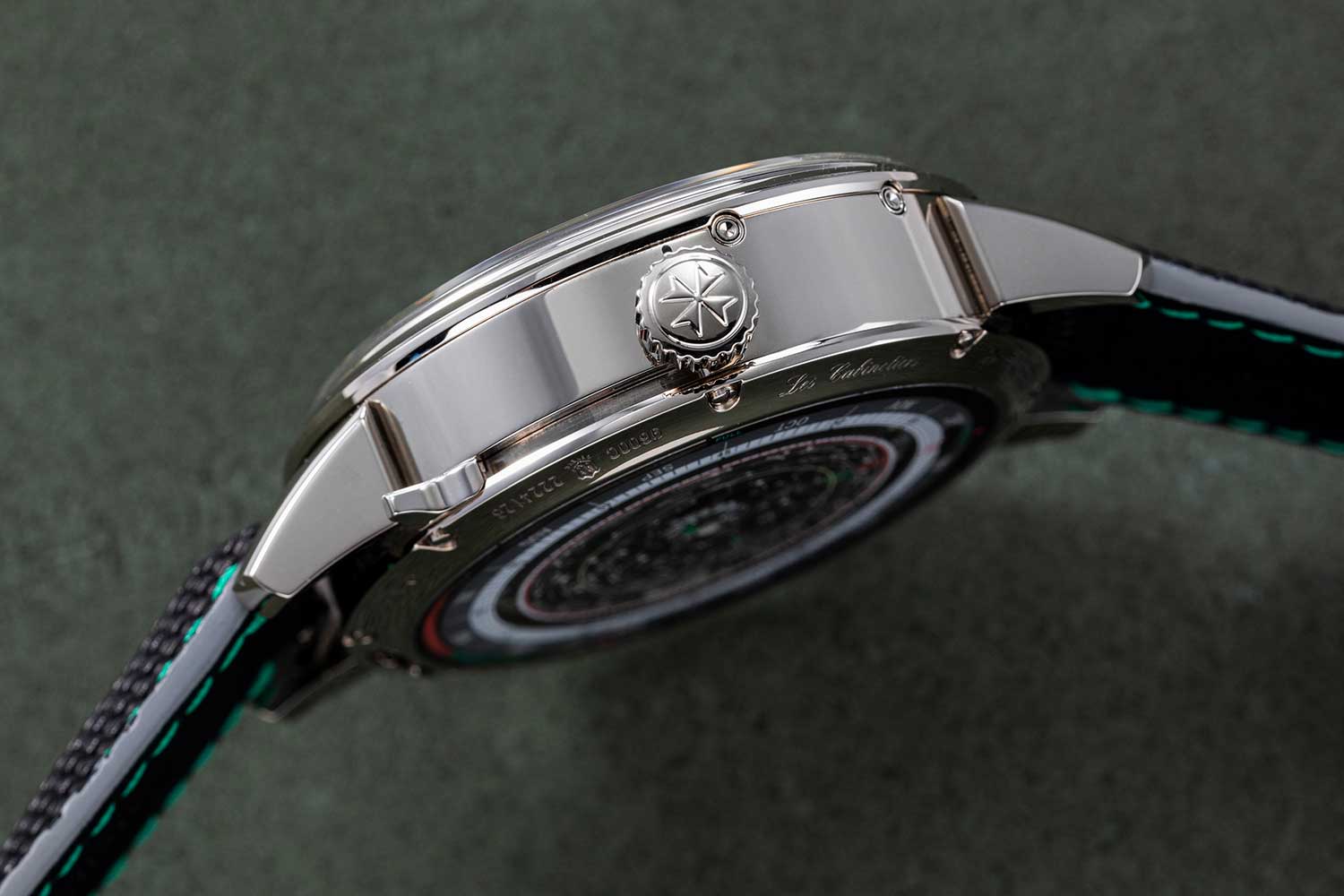
The movement of the selector is transmitted to an isolation lever inside the striking mechanism. In the hour-only mode, this lever swings into position to block the quarter rack, effectively disabling the quarter and minute strike while allowing the hour strike to proceed. In full Westminster mode, the isolation lever moves away, freeing the entire chiming train so that the watch can perform the complete Westminster sequence across four gongs and four hammers. The design of the striking mechanism is mindful of space constraints, incorporating several other solutions that minimise bulk. Additionally, the crown was designed to lock during chiming sequences, preventing any adjustments that could disrupt the timing or chiming function.
Ultimately, the Solaria is a highly accomplished watch, but its successes lie not just in the sheer number of complications it carries, but the depth of consideration given to each one, the elegance of their integration, the level of celestial detail encoded in its gear trains, its compactness, lastly, its astonishingly harmonious composition. It captures the magic of the heavens with a perfect balance of form and function.

Vacheron Constantin Les Cabinotiers Solaria Ultra Grand Complication (Revolution©)
The Complications (1 to 41)
Time measurement (6)
1. Day and night indication for reference city
2. Second time zone hours and minutes (on 24-hour display)
3. World time indication for 24 cities
4. Second time zone day and night indication
5. 3Hz tourbillon with silicon balance wheel (with high Q factor)
6. Civil time display module coupled to the base movement
Gregorian Perpetual Calendar (8)
7. Perpetual calendar
8. Days of the week
9. Date
10. Months
11. Year indication
12. Leap-year indication
13. Indication for the number of the week within the year (ISO 8601 calendar)
14. Number of the day of the week (ISO 8601 calendar)
Lunar indications (3)
15. Astronomical Moon phases and age of the Moon
16. Tide level indicator
17. Spring and neap tides indication
Astronomical indications (14)
18. Indication of seasons, equinoxes & solstices
19. Position of the Sun
20. Sunrise time (according to the city of reference)
21. Sunset time (according to the city of reference)
22. Duration of the day (according to the city of reference)
23. Equation of time on tropical (solar) gear
24. Culmination time of the Sun (according to the city of reference)
25. Height of the Sun above the horizon (according to the city of reference)
26. Declination of the Sun, Three-dimensional Earth showing the latitude of the Sun in
the Northern/Southern hemisphere
27. Sidereal hours
28. Sidereal minutes
29. Astronomical zodiac signs
30. Sky chart (according to the city of reference)
31. Temporal tracking of celestial objects
Chiming complications (5)
32. Minute repeater
33. 34. 35. Westminster carillon chime (4 hammers & 4 gongs)
Choice of hour-only or full chime
Crown locking system during the chiming
36. Double-stop hammer system to limit rebound and optimise transmission of the
hammers’ kinetic energy
Split-seconds Chronograph (4)
37. Chronograph (1 column wheel)
38. 60-minute counter
39. 40. Additional feature (1)
41. Split-seconds chronograph (1 column wheel); Isolator system for the split-seconds chronograph; Power-reserve indication (outer disc at 190°)
Tech Specs: Vacheron Constantin Les Cabinotiers Solaria Ultra Grand Complication
Movement: Manually wound, 72-hour power reserve; 3 Hz (21,600 vph)
Case: 45mm diameter by 14.99mm thick, 18K white gold
Dial: (Front) metal black-coloured sunray satin-finished with circular satin-finished edge; 18K white gold hour-markers; sandblasted counters; Earth applique: polished and sandblasted rhodium-finished 18K 3N yellow gold; Sun sphere: 18K 3N yellow gold; (Back) grey-tinted sapphire crystal with celestial vault made by metallisation; Chronograph and split-seconds chronograph hands; lacquered aluminium alloy
Strap: Black technical calfskin leather strap with a textured effect and calfskin leather inner shell
Availability: Single-piece edition
Vacheron Constantin
You may also like
Editorial
The Revolutionary List: 30 Pioneering Watches – Vacheron Constantin
Dec 2, 2025
Editorial
The Revolutionary List: 30 Pioneering Watches – Vacheron Constantin
Dec 2, 2025

Editorial
The Revolutionary List – 26 Inspirational Leaders: Louis Ferla
Dec 1, 2025
Editorial
The Revolutionary List – 26 Inspirational Leaders: Louis Ferla
Dec 1, 2025

Editorial
The latest Vacheron Constantin Les Cabinotiers watches celebrate art, science and myth
Nov 6, 2025
Editorial
The latest Vacheron Constantin Les Cabinotiers watches celebrate art, science and myth
Nov 6, 2025