The Revolutionary List: 24 Technically Brilliant Watches – F.P. Journe Chronomètre Optimum
Editorial
The Revolutionary List: 24 Technically Brilliant Watches – F.P. Journe Chronomètre Optimum

This year, Revolution turns 20. Two decades of chronicling watches, people and ideas have given us a front-row seat to a remarkable story: how an age-old craft has both preserved its soul and reinvented itself for the 21st century. To celebrate, we’ve chosen over 100 names and milestones that, for us, define the era so far. From leaders to watches, you can see the whole list here.
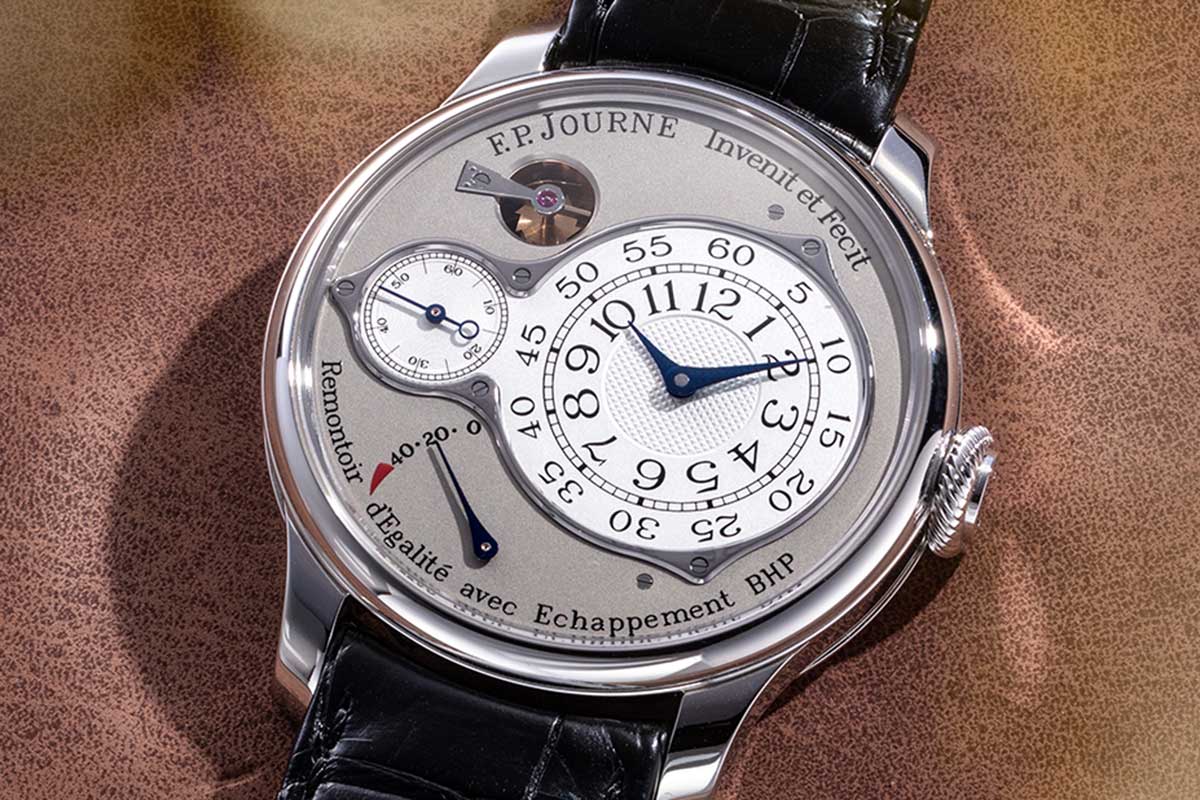
The Chronomètre Optimum is, in some sense, François-Paul Journe’s most paradoxical creation. It is a watch that shows nothing more than hours, minutes, seconds and the state of wind, yet it is one of the most ambitious time-only watches of the modern era and, arguably, his purest effort in the pursuit of precision. At its heart lies a simple principle — a linear source of power and an escapement that could translate that power with efficiency and stability. The Chronomètre Optimum pursues this ideal with a movement built around twin barrels arranged in parallel, a remontoir d’égalité and Journe’s own vision of the natural escapement.
Barrels in series discharge one after the other and are chiefly a means of extending the running time. In parallel, they work in unison, reinforcing one another to provide a higher and more constant flow of torque. Additionally, as they each drive the center wheel pinion from opposing sides, it eases the load on the pivots and reduces friction.
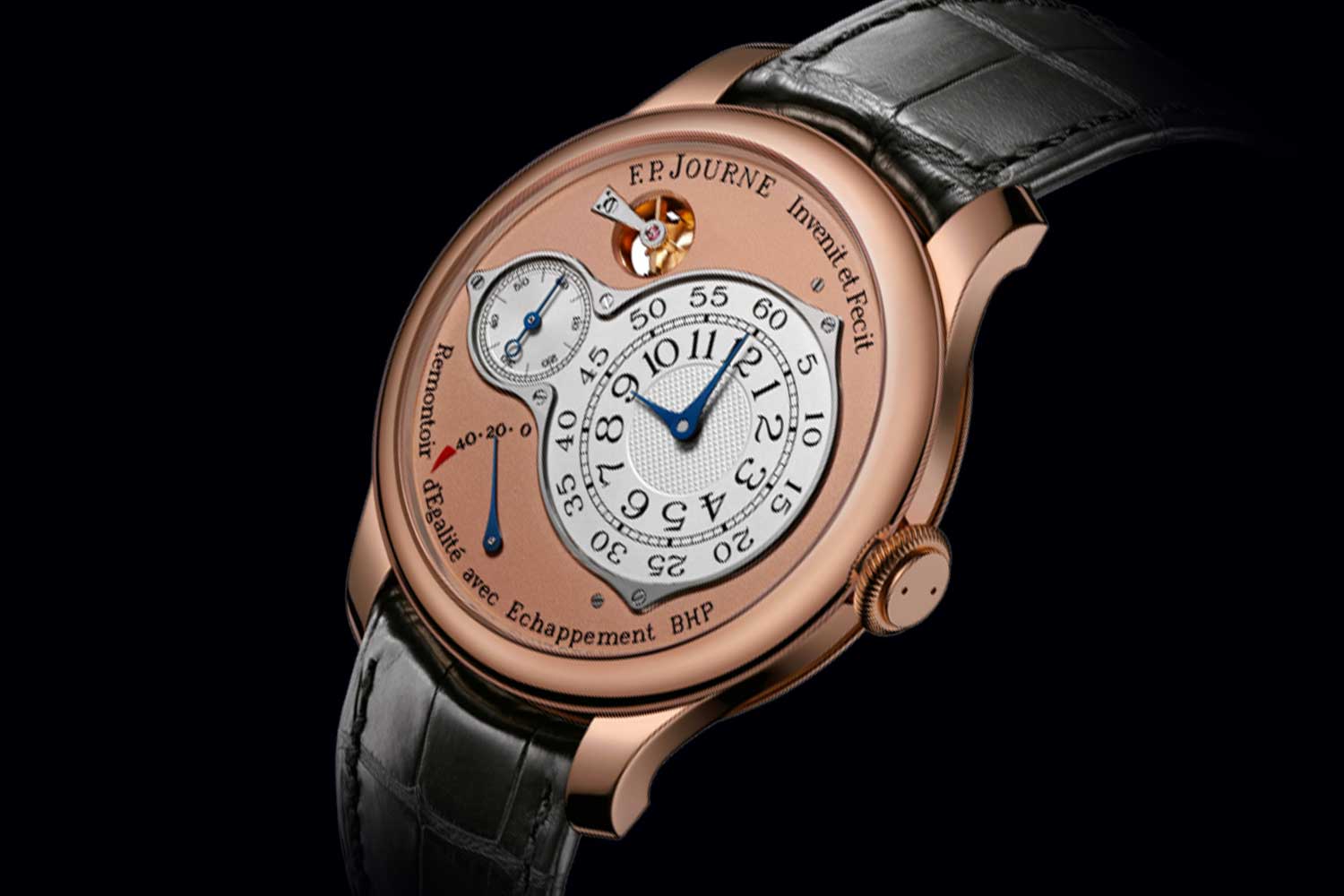
F.P. Journe Chronomètre Optimum
From there, the energy is regulated by a remontoir d’égalité. Journe’s design, first used in the 1999 Tourbillon Souverain, relies on a steel blade spring fixed to the baseplate. This spring is loaded when a pivoting lever, carrying an intermediate wheel between the fourth wheel and the escapement drive wheel, swings into contact with it.
The lever pivots around the axis of the escapement drive wheel. One end bears against the remontoir spring, while the other carries a pallet that locks into a stop wheel. As torque from the mainspring passes through the train, it drives the lever counter clockwise around the escapement drive wheel, deflecting the spring and storing energy until the pallet drops into the stop wheel. At that instant, the train is arrested and the escapement is completely isolated from the barrel.
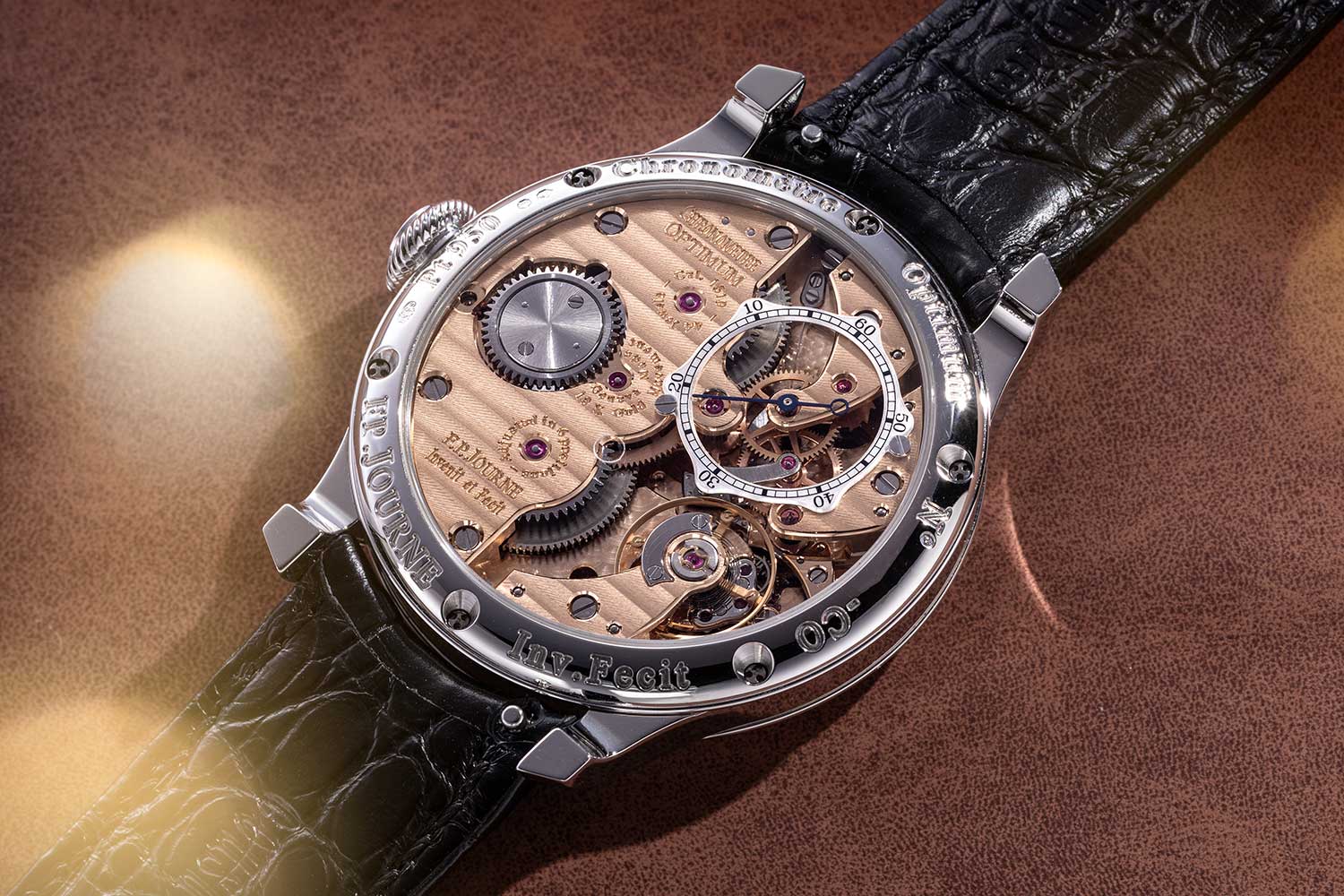
The natural dead beat second in the back (©Revolution)
During this pause, the escapement is powered only by the remontoir spring. With the fourth wheel pinion held stationary, the escapement drive wheel is free to turn. As the spring discharges, it pushes the lever back clockwise, letting the intermediate wheel rotate against the fixed fourth wheel pinion. This rotation is passed to the escapement drive wheel and onward to the escapement itself. The effect can be seen from the back as a deadbeat seconds display, ticking once per second.
The escapement dubbed the Bi-Axial High-Performance Escapement is based on the principles of Breguet’s natural escapement, so called as it delivers two impulses directly and tangentially to the balance wheel at each cycle without the intermediation of a lever and without oil. Instead, a central lever serves to alternately lock the escape wheels. The two escape wheels are each mounted on their own arbors and geared together so that one is driven directly by the train and the other follows in opposition. Notably, the escapement was designed such that when the balance is at rest, neither escape wheel is held by a locking pallet, which allows the escapement to start on its own as soon as power is applied. The lever is prevented from accidentally unlocking in the event of a shock by a guard pin and safety roller, which is the classic anti-shock system of lever escapements.
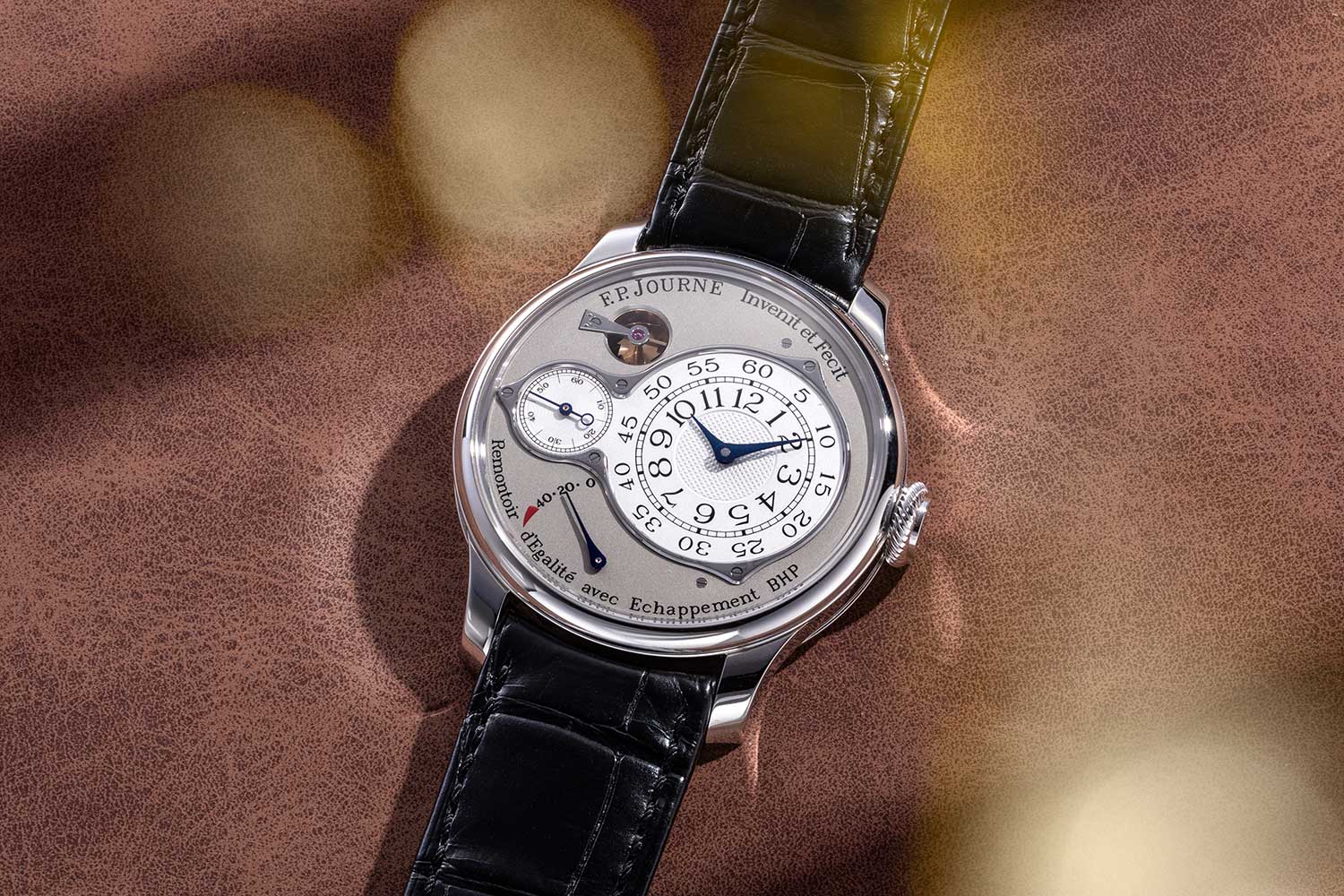
F.P. Journe Chronomètre Optimum (©Revolution)
The Chronomètre Optimum is, hence, outwardly simple in function but extravagant in construction and one of the most sophisticated statements of precision watchmaking in our time.
Tech Specs: F.P. Journe Chronomètre Optimum
Movement Manual winding Caliber 1510; 70-hour power reserve
Functions Hours, minutes and small seconds; deadbeat seconds indicator on the reverse
Case 40mm or 42mm, both with 9.5mm thickness; platinum or 6N gold; water resistant to 30m
Dial 18K white gold (platinum version) or 5N gold (rose gold version) with whitened guilloché and silvered subdials
Strap Black alligator with pin buckle
F.P. Journe
You may also like

Editorial
The Revolutionary List: 25 Watchmakers and Construction – François-Paul Journe
Dec 15, 2025
Editorial
The Revolutionary List: 25 Watchmakers and Construction – François-Paul Journe
Dec 15, 2025
Editorial
The Revolutionary List: 30 Pioneering Watches – the F.P. Journe Chronomètre à Résonance
Dec 2, 2025
Editorial
The Revolutionary List: 30 Pioneering Watches – the F.P. Journe Chronomètre à Résonance
Dec 2, 2025

Editorial
The Revolutionary List – 26 Inspirational Leaders: François-Paul Journe
Dec 1, 2025
Editorial
The Revolutionary List – 26 Inspirational Leaders: François-Paul Journe
Dec 1, 2025