The Revolutionary List: 24 Technically Brilliant Watches – Blancpain Villeret Tourbillon Carrousel
Editorial
The Revolutionary List: 24 Technically Brilliant Watches – Blancpain Villeret Tourbillon Carrousel

This year, Revolution turns 20. Two decades of chronicling watches, people and ideas have given us a front-row seat to a remarkable story: how an age-old craft has both preserved its soul and reinvented itself for the 21st century. To celebrate, we’ve chosen over 100 names and milestones that, for us, define the era so far. From leaders to watches, you can see the whole list here.
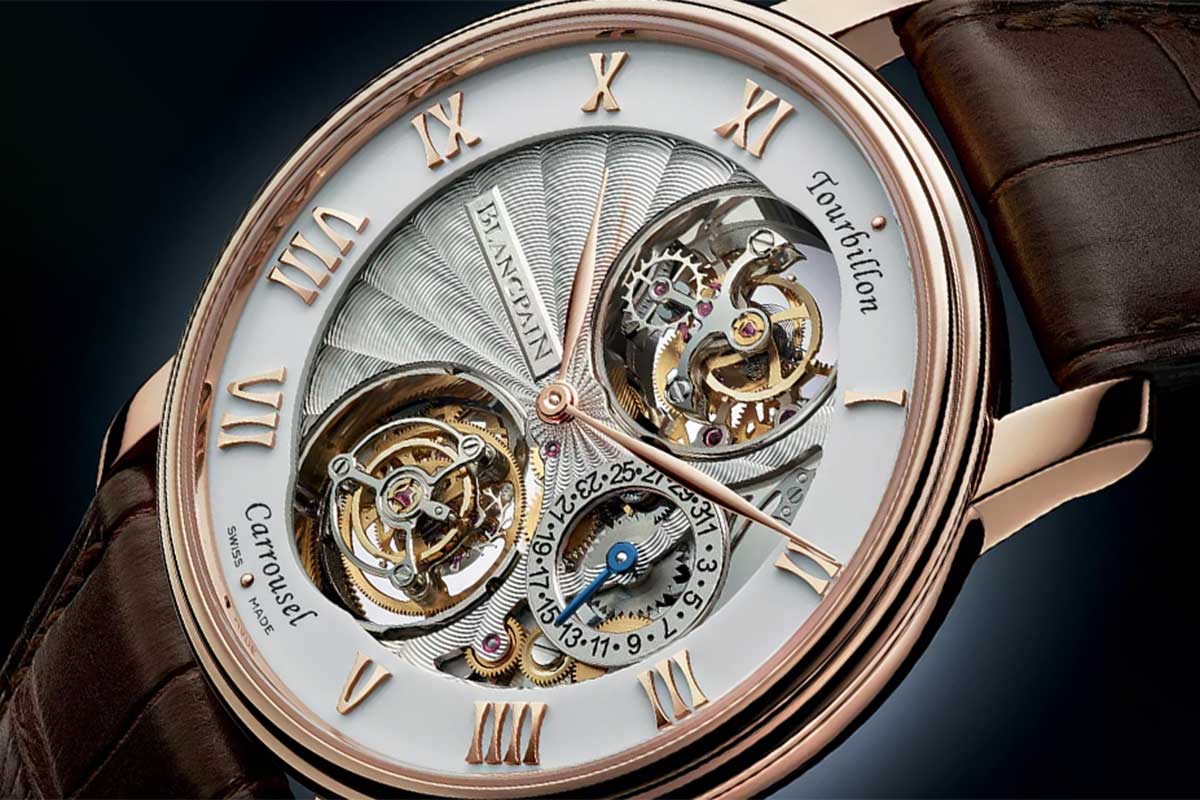
The Blancpain Villeret Tourbillon Carrousel, launched in 2013, is one of those watches that continues to be talked about long after its debut. That has less to do with novelty than with the peculiar fact that it is the only watch to take two of the most elaborate solutions ever proposed to the problem of positional errors, and put them into the same movement in the most intelligible way.
It is well known that Breguet received the first patent for the tourbillon in 1801, and its purpose was to mitigate positional errors by carrying the balance in a cage that made one revolution per minute. The principle is straightforward. By mounting the escapement, balance and hairspring on a rotating platform, the errors that arise in the vertical positions are averaged into a single mean rate.

In practice, however, the mechanics are less straightforward. In a tourbillon, the fourth wheel pinion drives the cage, and the cage in turn carries the escape wheel, which meshes back with the fixed fourth wheel. This means that the regulating organ — the escape wheel and balance — is not supplied power in isolation. Its operation depends on the residual torque available after overcoming the inertia and friction of the cage itself. The escapement is thus always working within the constraint that part of the energy from the train is continuously consumed by the cage.
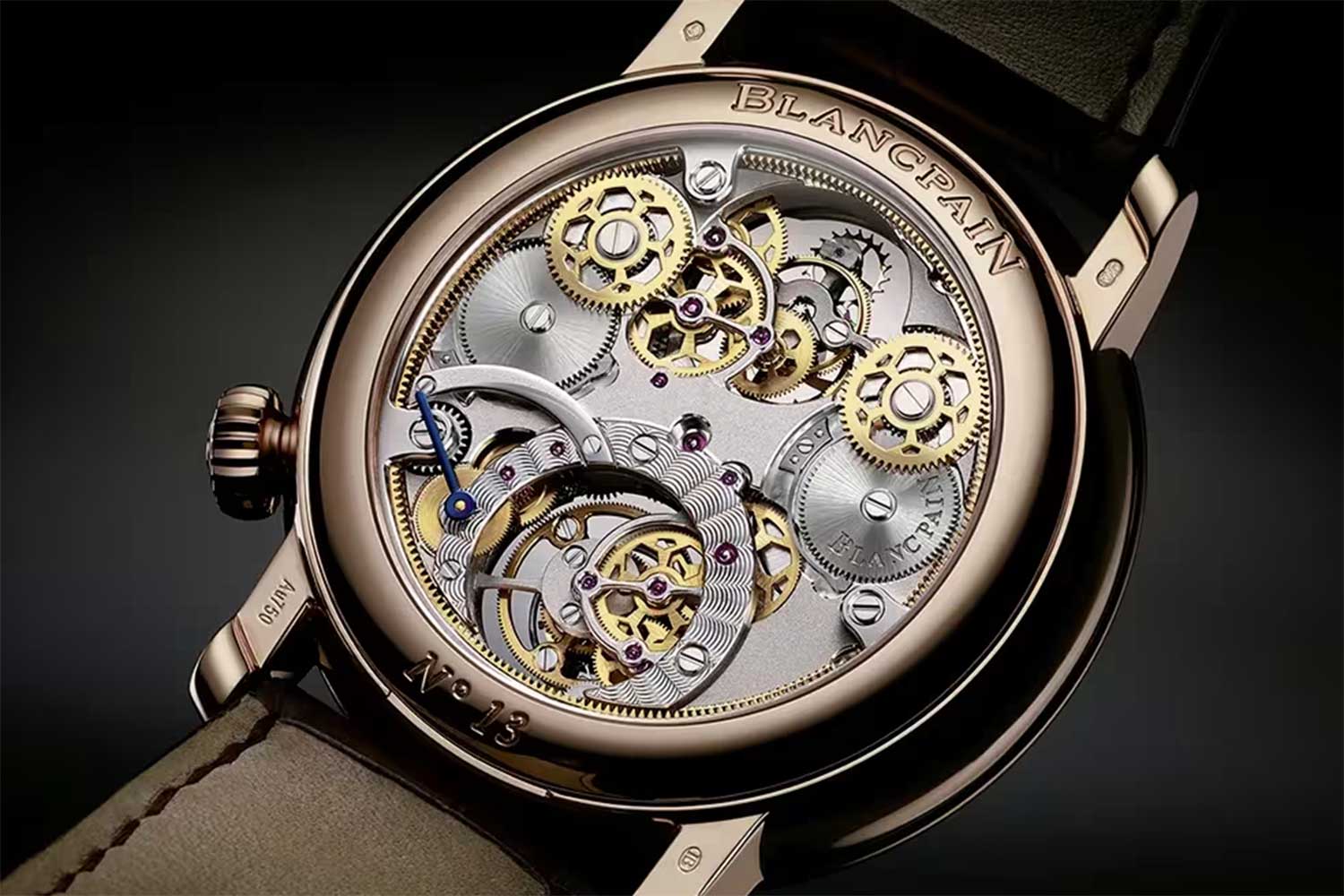
The carrousel, at its core, inverts that logic. The fourth wheel behaves conventionally and drives the escape wheel on the cage directly. At the same time, an auxiliary train from the center wheel powers the cage. Hence, instead of the cage determining what energy the escapement receives, the escapement is fed directly, while the cage is maintained in motion by a separate path.
The carrousel was patented in England by the Danish watchmaker Bahne Bonniksen in 1892. It was conceived as a more practical alternative, side stepping the severe demands for precision and finish that made tourbillons costly to build, while still delivering chronometric benefits. At the turn of the 20th century, carrousel chronometers found wide favor, and many of them were sent to Kew for trial where they showed themselves equal to the task.
Naturally, in the Blancpain Villeret Tourbillon Carrousel, both oscillators are powered by their own barrels and gear trains. The hand-winding mechanism is designed with a differential to distribute power equally to the two barrel ratchets when the watch is wound. At the same time, it regulates the rotational speeds of the barrels based on the mean speed of the two regulating systems and transmits this output directly to the time display. Set side by side, the two mechanisms offer a powerful visual comparison, with their distinct kinematics laid bare as parallel philosophies in the struggle with gravity.
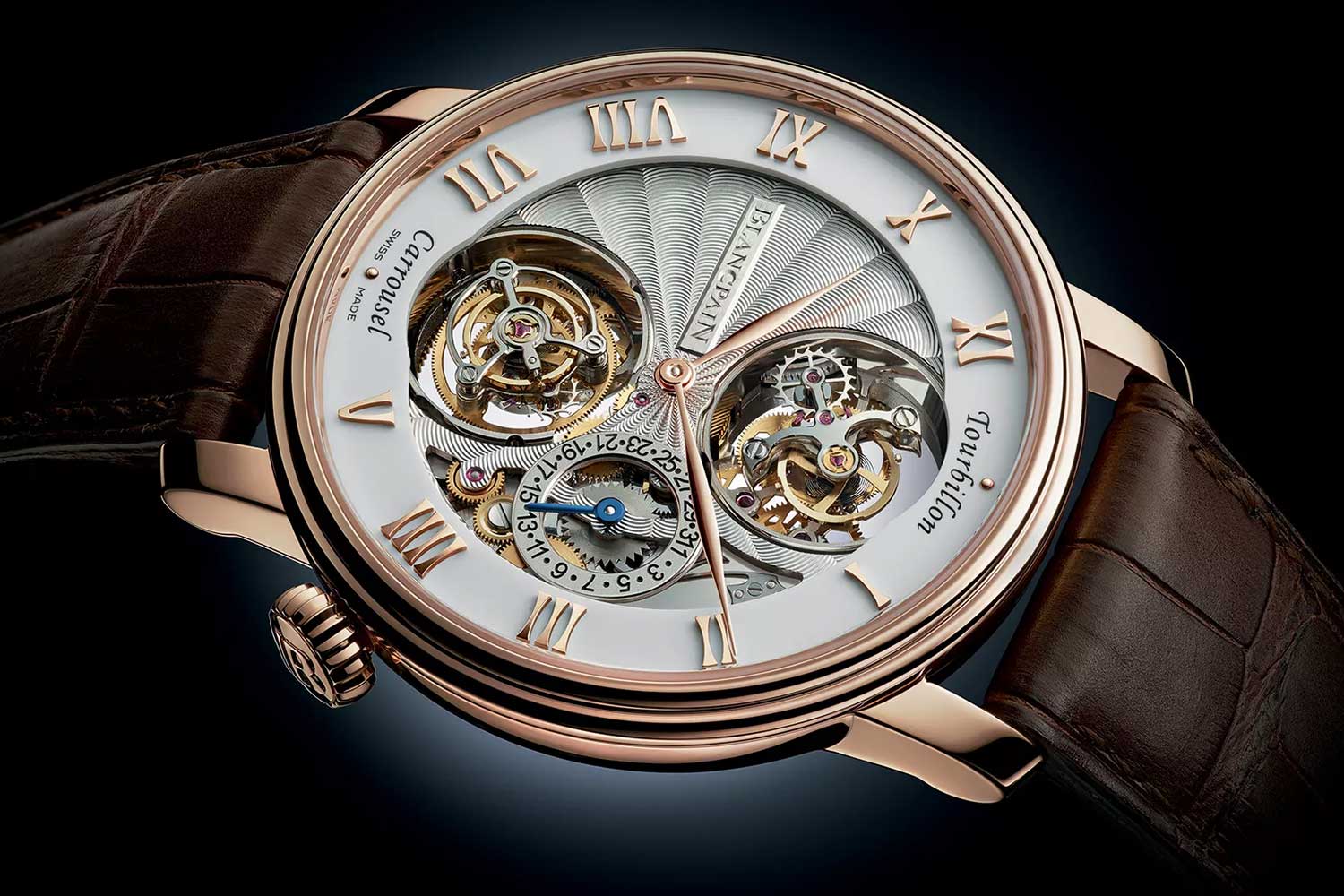
Tech Specs: Blancpain Villeret Tourbillon Carrousel
Movement Manual winding Caliber 2322; seven-day power reserve
Functions Hours, minutes and date; flying tourbillon at 12 o’clock; flying carrousel at 6 o’clock
Case 44.6mm × 11.9mm; 18K red gold; water resistant to 30m
Dial Open-worked with white grand feu enamel
Strap Brown alligator leather with folding clasp
Blancpain

You may also like
Editorial
The Revolutionary List: 24 Technically Brilliant Watches – the Blancpain Grande Double Sonnerie
Dec 12, 2025
Editorial
The Revolutionary List: 24 Technically Brilliant Watches – the Blancpain Grande Double Sonnerie
Dec 12, 2025

Editorial
The Revolutionary List – 26 Inspirational Leaders: Marc Hayek
Dec 1, 2025
Editorial
The Revolutionary List – 26 Inspirational Leaders: Marc Hayek
Dec 1, 2025
Editorial
Grand Ambition: Inside Blancpain’s Grande Double Sonnerie
Nov 24, 2025
Editorial
Grand Ambition: Inside Blancpain’s Grande Double Sonnerie
Nov 24, 2025